
Plenty of people still learn how to build quality backlinks from advice that stopped working years ago, then wonder why their links do nothing or get their site in trouble. Backlinks still matter in 2026. The old way of getting them doesn’t.
This guide starts with what a backlink is and what makes one high quality, then lays out 18 ways to earn links to your blog.
You’ll also see the strategies to avoid, how to judge a link before you chase it, how to pick natural anchor text and what nofollow, sponsored, and UGC tags mean. A 90-day plan for new websites wraps it up.
- What Is a Backlink?
- What Makes a Backlink High Quality?
- Are Backlinks Still Important for SEO in 2026?
- The New Link Building Mindset for 2026
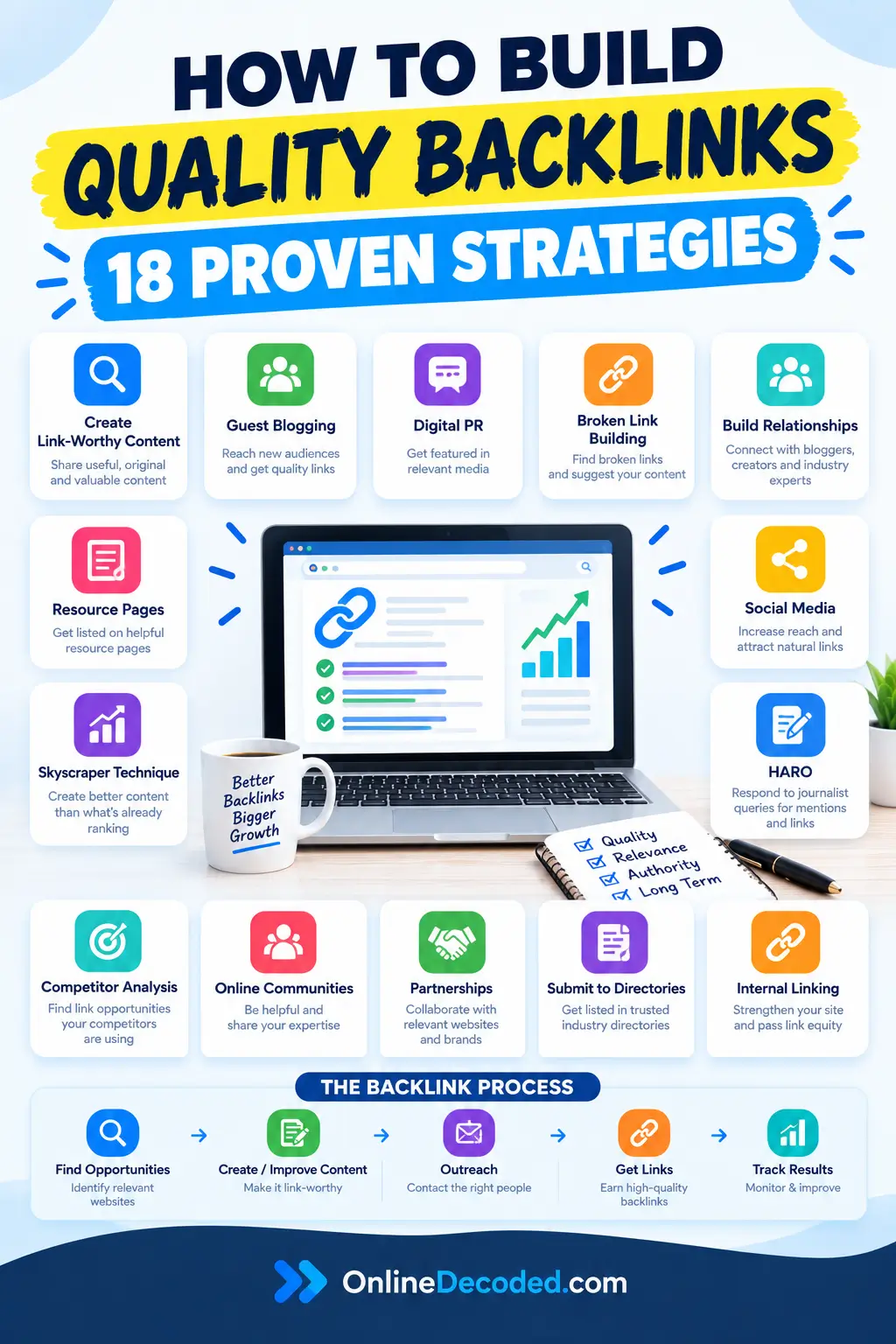
- 18 Ways to Build Quality Backlinks to Your Blog
- Publish Original Research
- Create Original Statistics
- Create Free Tools and Calculators
- Create Definitive Guides
- Publish Original Case Studies
- Create Link-Worthy Infographics
- Create Other Visual Assets
- Repurpose Content Into Multiple Formats
- Digital PR and Original Newsworthy Content
- Expert Commentary Through Modern Platforms
- Guest Posting on Quality Publications
- Broken Link Building
- Unlinked Brand Mentions
- Resource Page Outreach
- Content Refreshing (Skyscraper Method)
- Competitor Backlink Analysis
- Link Reclamation
- Build Genuine Partnerships
- Backlink Strategies You Should Avoid in 2026
- How to Evaluate a Backlink Before Building It?
- How to Choose Natural Anchor Text?
- Nofollow, Sponsored and UGC Links Explained
- A 90-Day Backlink Strategy for a New Website
- How Many Backlinks Do You Need To Rank Your Website?
- How to Monitor Your Backlinks
Quick Answer: Backlinks are still important in 2026, but quality and relevance matter far more than volume. Lists 18 ways to build quality backlinks to your blog. Covers strategies to avoid, how to evaluate a link and how to choose natural anchor text. Explains nofollow, sponsored and UGC links. Ends with a 90-day backlink plan for new websites.
Backlinks remain an important part of SEO in 2026, but the old way of building them is no longer a strategy you should rely on.
For years, link building often meant submitting websites to hundreds of directories, creating profile links, commenting on blogs, posting links in forums, publishing thin Web 2.0 articles, or searching for websites that offered “dofollow” backlinks.
The problem is that creating large numbers of links simply to influence search rankings can cross into link spam.
Google’s current spam policies specifically identify practices such as buying or selling links for ranking purposes, automated link creation, low-quality directory and bookmark links, optimised links in forum comments, excessive link exchanges and low-value content created primarily to manipulate ranking signals.
So what should you do instead?
Build things that deserve to be linked to.
In 2026, effective link building is less about finding websites that allow you to drop a URL and more about creating useful resources, original research, tools, statistics, guides and other assets that publishers and audiences genuinely want to reference.
You can also earn links by sharing your expertise through digital PR, expert interviews, and genuine relationships with other website owners.
This guide explains the proven ways to build quality backlinks in 2026, the outdated tactics you should avoid, how to evaluate a backlink opportunity, and how to create a sustainable 90-day link-building campaign.
The goal isn’t to build the most backlinks. The goal is to build the right backlinks.
Before we dive into the ways to build backlinks, let us see what a backlink is and why it still matters.
What Is a Backlink?
A backlink is a link from one website to another.
How Do Backlinks Work?
When Website A links to Website B, that’s a backlink for Website B. Backlinks function as citations.
If a high-authority website references your content, Google interprets that link as a vote of confidence, a signal that your content is credible and valuable.
Why Websites Link to Other Websites?
Websites link to other websites to provide source material, cite data or research, recommend useful tools to readers, credit ideas or inspiration, or support claims with evidence.
In editorial contexts, links exist because the linking website genuinely believes readers should see that resource.
Backlinks vs. Referring Domains
A backlink is a single link. A referring domain is a unique domain that links to you. One website might link to you 50 times, but that counts as one referring domain.
Google prioritises referring domains over total backlink count. Having 50 unique websites linking to you once each is more powerful than one website linking to you 50 times.
Backlinks, Rankings and Referral Traffic
Backlinks influence rankings, but they also deliver direct referral traffic. When a user clicks a link from another website to reach your site, that’s referral traffic.
High-quality links from relevant websites tend to send traffic that is engaged and likely to convert, because visitors arrived through a trusted recommendation.
What Makes a Backlink High Quality?
Let us see the factors that make a backlink high quality.
Relevance
A backlink from a website in your industry carries more weight than a link from an unrelated website.
Topical relevance signals that the linking website genuinely believes your content is valuable within that subject area.
Editorial Context
A backlink embedded within a paragraph of relevant content is more valuable than a link placed in a sidebar, footer, or random list.
Editorial context signals the link was placed to support the surrounding content, not for transactional reasons.
Website and Page Quality
The quality of the linking website matters. A link from a well-maintained, professional website carries more weight than a link from a website with poor content quality or known spam tactics.
Evaluate the specific page too; links from high-traffic, well-linked pages pass more authority.
Real Audience and Referral Traffic
One of the strongest quality signals is whether the linking website has a real audience.
A website with 10,000 monthly visitors that links to you is more valuable than a website with zero visitors. Links that actually generate referral traffic prove the link reaches real people.
Natural Link Placement
Links that appear in natural, unforced contexts carry more weight than links that appear forced or unnatural.
A link placed to support content is a natural link. A link placed awkwardly or designed only for SEO is an unnatural link.
Natural Anchor Text
Anchor text is the visible text of a link. Natural anchor text is descriptive and readable. Exact-match anchor text that’s perfectly optimised for keywords can signal manipulation.
Over-optimised anchor text patterns are red flags for link manipulation.
Topical Relevance
The link should come from content discussing topics related to your site.
A link from an article about “best WordPress hosting” is more relevant than a link from an article about “home fitness equipment.” Google evaluates whether the linking page’s topic aligns with your content.
Why Domain Authority Isn’t a Google Metric
Many SEO tools assign metrics like “Domain Authority.” These are third-party metrics; Google doesn’t use them. Use third-party metrics as prospecting indicators, not as proof a link is valuable.
A website with low DA but real traffic and genuine relevance can provide more valuable links than a high-DA website with manipulated traffic.
Are Backlinks Still Important for SEO in 2026?
Let us see whether backlinks are still important in SEO.
Google’s Current Position on Links
Google’s current position is clear: links remain an important ranking signal. Backlinks are consistently among the top three ranking signals along with content quality and site authority. What changed is how strictly Google evaluates link quality.
Why Quality Matters More Than Quantity
One high-quality link from a relevant, authoritative website often produces more ranking benefit than 100 low-quality links from irrelevant directories.
Google’s algorithm evaluates link quality before link quantity. A low-quality link contributes minimal ranking benefit. 1,000 low-quality links might not match the impact of one high-quality link.
Why 100 Relevant Links Can Be Better Than 10,000 Random Links
100 links from relevant, topically aligned websites with real audiences signal strong authority.
10,000 links from random directories and link farms contribute minimal ranking benefit and may trigger spam penalties.
Quality + Relevance + Authority = Ranking Impact.
Links That Generate Traffic vs. Links Created Only for SEO
The best backlinks serve two purposes: they improve rankings, and they generate referral traffic from real people.
Links created purely for SEO and links that no real person would click contribute less to rankings and provide no business benefit.
Evaluate links based on dual criteria: Will this improve rankings? Will this send qualified visitors?
Before you build new links, check what you already have with these free backlink checkers. For deeper data, my SEO PowerSuite review and Semrush review compare two tools I’ve used for link research.
The New Link Building Mindset for 2026
Stop Chasing Backlink Counts
Shift from tracking total backlinks to tracking referring domains, link quality, and ranking improvements.
Monitor whether your link-building efforts actually produce rankings and traffic, not just growing a number in an SEO tool.
Start Creating Link-Worthy Assets
Instead of asking “where can I submit a backlink,” ask “what should I create that would be worth linking to?”
Link-worthy assets include original research, comprehensive guides, useful tools, statistics and data, case studies, infographics, and resources.
Build Relationships Before Asking for Links
Link building is relationship building. Publishers and website owners are more likely to link to you if they know you, trust you, and understand your expertise.
Build relationships by contributing helpful content, engaging authentically, and providing value before requesting anything.
Think About Readers First
Every link decision should start with: “Would this link genuinely help readers?” Links placed to serve readers are the links Google rewards. This applies to your own linking decisions too.
Internal links should serve readers first, SEO second.
Build Links You Would Want Even Without Google
Imagine Google didn’t exist.
Would you still want this link?
If the answer is yes, pursue it. If the answer is only “yes because of SEO,” reconsider.
18 Ways to Build Quality Backlinks to Your Blog

Let us see the best ways to build quality backlinks to your website.
Publish Original Research
Conduct surveys or collect data within your industry. Surveys of 100-500 people that reveal unexpected insights become linkable assets.
Document your methodology clearly so other writers can confidently cite your research.
One research study can generate 30-50 editorial links over time as different articles reference it.
Create Original Statistics
Build a dedicated page aggregating statistics you’ve collected or analysed from primary sources.
Update your statistics page regularly; current data attracts more citations. When other writers cover your topic, they search for statistics to include.
Make your statistics available, and they’ll cite you.
Create Free Tools and Calculators
Build interactive tools that solve specific problems in your industry. Free tools and calculators are the highest-performing link magnets in 2026.
Useful tools generate passive links over years because site owners naturally recommend them to readers.
Examples: SEO calculator, word counter, image optimiser, website speed checker, meta title checker.
Create Definitive Guides
Identify gaps in existing content and create comprehensive guides that are genuinely better. Comprehensive ultimate guides become reference resources that other writers link to when explaining topics.
Include 3,000+ words with original diagrams, case studies, and practical frameworks. Keep guides updated; current resources continue attracting links.
Publish Original Case Studies
Document specific problems, your approach, and real results with actual data. Case studies are highly linkable because other writers can cite actual outcomes.
Include specific numbers, metrics, and before/after results. Real case studies become examples other writers reference to prove an approach works.
Create Link-Worthy Infographics
Base infographics on original data or research, not generic visuals. Infographics based on original findings attract links from other blogs and industry sites.
Publish on your website first with full context, then promote to relevant publishers. Readers share infographics that visualise surprising data.
Create Other Visual Assets
Publish charts, diagrams, screenshots, comparison tables, flowcharts, or illustrations that illustrate important concepts.
Make assets embeddable by providing HTML embed code so other websites can use them while crediting you.
Include attribution information so publishers properly credit you.
Repurpose Content Into Multiple Formats
Turn one comprehensive article into an infographic, PDF, presentation, video, podcast episode, checklist, or downloadable template.
Different formats reach different audiences and create new opportunities for links.
Publish the original content first, then distribute repurposed versions across relevant channels.
Digital PR and Original Newsworthy Content
Create newsworthy content, original research, industry surveys, trend analysis, or expert commentary and pitch it to journalists at major publications.
When journalists cover your story, they include attribution links.
One well-executed data study earns 50-200 links from high-authority publications (DA 70+) that would be impossible to obtain otherwise.
Expert Commentary Through Modern Platforms
Respond to journalist queries on platforms like Qwoted, Connectively, Featured.com, or directly on X and LinkedIn.
When journalists use your commentary in published articles, they include attribution and links. This method works because journalists constantly need expert perspectives to support their stories.
Quality responses increase the likelihood journalists will use your quote.
Guest Posting on Quality Publications
Contribute comprehensive, valuable content: 2,500+ words with original research or frameworks to publications your audience already reads.
This isn’t thin content for links. This is genuinely valuable content contributing to publications.
Include 1-2 contextual links within the article because they fit naturally. Link to your best resource, not your homepage.
Broken Link Building
Find broken external links on relevant websites using tools like Ahrefs or SEMrush. Identify what the broken link was pointing to, then create better content on that topic.
Contact the website owner with a specific, helpful pitch offering your resource as a better replacement.
Success rate is 20-50%, and it works because you’re helping the site improve.
Unlinked Brand Mentions
Use tools like Mention or Google Alerts to find brand mentions without links.
Contact the publisher and ask if adding a quick link would be helpful for their readers.
Many site owners are happy to add a link when they realise they referenced you without linking.
Resource Page Outreach
Identify curated resource pages in your niche. Verify your content is genuinely more comprehensive or valuable than existing resources.
Contact site owners with specific, personalised pitches explaining why your resource fits their page.
Avoid mass submissions; quality personalised outreach outperforms bulk submissions.
Content Refreshing (Skyscraper Method)
Find popular existing content that has earned many backlinks.
Create a 2026 version with new data, updated examples, and a downloadable checklist. Reach out to sites linking to the older post and pitch your more current resource.
A percentage will update their links to your newer, better version.
Competitor Backlink Analysis
Identify which websites link to your competitors. Find legitimate link opportunities that make sense for your website.
Don’t copy competitors’ entire backlink profiles; instead, find legitimate opportunities unique to your content strengths.
Link Reclamation
Use backlink tools to identify links you’ve lost over time.
For links that broke because of page moves, implement permanent 301 redirects appropriately. For links pointing to outdated content, create updated versions and request link updates.
Google confirms permanent redirects can transfer signals when URLs are moved appropriately.
Build Genuine Partnerships
Most good links come from people, not tools. My guide on how to build strong relationships with bloggers covers the outreach side.
Collaborate with complementary service providers or industry peers. Strategic partnerships that create mutual value generate long-term backlinks.
These backlinks are often highly relevant and long-lasting because they’re based on genuine collaboration.
Backlink Strategies You Should Avoid in 2026
Let us see the backlink strategies that you should avoid implementing in 2026.
Buying Links for Ranking
Purchasing links specifically for ranking benefits violates Google’s policies. If the primary purpose is ranking manipulation, it’s a violation.
Discovered link-buying schemes result in penalties.
Automated Backlink Software
Software that automatically creates links, submits websites to directories, or generates profiles violates policies.
These systems create artificial patterns that Google detects and flags instantly.
Mass Blog Commenting or Forum Posting
Commenting on hundreds of blogs with your link primarily for backlinks violates policies.
Blog comments should contribute to genuine discussion. Forum participation should be authentic, not link-focused.
Bulk Profile Creation
Creating profiles across multiple websites primarily for backlinks violates policies.
Profiles created only for link-building are artificial and detectable.
Low-Quality Directory Submission
Submitting websites to hundreds of low-quality directories violates policies.
Google specifically identifies low-quality directory links as link spam examples.
Mass Web 2.0 Link Building
Creating articles across multiple platforms primarily for backlinks violates policies.
Web 2.0 platforms have legitimate uses for content distribution, but mass link-building abuse is flagged.
Private Blog Networks (PBNs)
PBNs (networks of websites created solely for linking to client websites) violate policies.
These are artificial link schemes designed to manipulate rankings.
Keyword-Stuffed Anchor Text
Using exact-match keywords as anchor text excessively signals manipulation. Natural anchor text varies.
Over-optimisation is a red flag for link manipulation.
Excessive Link Exchanges
Trading links in excessive quantities violates policies. One or two mutual links between relevant sites are normal.
Coordinated link exchanges are not.
AI-Generated Content Created Primarily for Links
Creating low-quality AI content solely to acquire links violates policies. Content must have genuine value independent of link goals.
How to Evaluate a Backlink Before Building It?
Is the Website Topically Relevant?
Does the linking website cover topics related to your industry? A relevant link signals authority within your topic area.
Does It Have a Real Audience?
Does the website have genuine organic traffic? Would a real person visit for content value? Check if the website ranks for relevant keywords.
Would the Link Help Readers?
If you remove the SEO element, would this link genuinely help readers? If no, the link exists only for SEO purposes.
Is the Link Editorially Appropriate?
Does the link fit naturally within content context? Is it placed where an editor who cared about readers would place it?
Is the Page Actually Indexed?
Confirm the page containing your link is indexed by Google. Check Google Search Console or search for the URL directly.
Is the Website Full of Spam?
Does the website have obvious quality issues: excessive ads, low-quality content, suspicious link patterns, or design problems?
Is the Anchor Text Natural?
Is the link text descriptive and readable, or is it exact-match keyword-stuffed? Natural anchor text makes sense in context.
Could the Link Generate Referral Traffic?
Is there any reasonable chance a real person would click this link and visit your website?
Would You Want the Link Without SEO Benefits?
This is the core question. If Google didn’t exist, would you still want this link? If yes, pursue it. If only “yes because of SEO,” reconsider.
How to Choose Natural Anchor Text?
Let us see how to choose a natural anchor text for your backlink.
Branded Anchors
Branded anchor text uses your brand name: “OnlineDecoded” or “Visit OnlineDecoded.” These are natural and safe.
Naked URLs
Naked URLs are the link URL itself: “https://onlinedecoded.com.” These are natural and occur frequently.
Partial-Match Anchors
Partial-match anchors use general phrases with your brand: “the OnlineDecoded guide.” These are natural and recommended.
Descriptive Anchors
Descriptive anchors describe the page: “this comprehensive guide” or “the latest research.” These are natural and recommended.
Exact-Match Anchors
Exact-match anchors use your target keyword precisely. These should be rare. Overuse signals keyword optimisation and can trigger penalties.
Why Over-Optimized Anchors Are Risky
If 80% of your anchor text is exact-match keywords, that pattern signals manipulation. Natural anchor text varies. A diverse anchor text profile looks organic and passes more weight.
Nofollow, Sponsored and UGC Links Explained
What Is a Nofollow Link?
A nofollow link includes rel=”nofollow” in the HTML code. This attribute tells Google: “I’m not endorsing this link for ranking purposes.” Nofollow links don’t pass ranking value but can drive referral traffic.
What Is a Sponsored Link?
Sponsored links include rel=”sponsored” and indicate the link was paid for or provided in exchange for value. These links don’t pass ranking benefit.
What Is a UGC Link?
UGC links include rel=”ugc” (User Generated Content) and indicate the link was created by users, not the website owner.
Comments commonly use UGC tags. They don’t pass ranking value.
When Should Each Attribute Be Used?
Use nofollow for links you don’t personally endorse. Use sponsored for paid links or sponsorships.
Use UGC for user-generated links in comments or forums. For links you personally create and endorse, use no attribute (dofollow is the default).
Should You Ignore Nofollow Links?
No. While nofollow links don’t pass ranking value, they generate referral traffic, build brand awareness, create trust signals through citation, and contribute to link diversity.
Starting a new site? An aged domain can give you a head start, and this guide on buying expired domains explains how to check one before you pay.
As links come in, track progress with this post on how to increase domain authority, and promote every new piece using my blog promotion guide.
A 90-Day Backlink Strategy for a New Website
Let us see the 90-day backlink strategy to build quality backlinks to your website.
Days 1–30: Build Linkable Assets
Create foundational assets designed to attract links:
- 2–3 comprehensive guides (2,500- 5,000 words each)
- 1 original research piece or survey
- 1 free tool or template
- 1 statistics resource or data compilation
- 3-5 visual assets (infographics, comparison charts, flowcharts)
Build first. Worry about promotion later.
Days 31–60: Promotion and Outreach
With assets created, begin targeted outreach:
- Identify 50-100 websites in your niche
- Search for journalists covering your industry
- Create a list of relevant resource pages and blogs
- Begin outreach introducing your assets
- Pitch to 5-10 journalists with research or expertise
- Reach out to 10-15 resource page owners
- Engage in relevant communities sharing your resources
Don’t ask directly for links. Share resources and let recipients decide.
Days 61–90: Reclamation and Expansion
Focus on maximising links earned and capturing opportunities:
- Search for brand mentions without links
- Search for broken links on relevant sites
- Identify competitor links and research similar opportunities
- Follow up with earlier contacts
- Analyse which assets attracted the most links
- Plan the next 90-day cycle based on what worked
By day 90, a new website pursuing this strategy might have 15-30 quality backlinks.
How Many Backlinks Do You Need To Rank Your Website?
The following is a simple method which is used to calculate the number of backlinks you need to rank your website.
I learned it from a webinar by Blog with Jags. I am sharing it here as it will be helpful for many.
1. Check the first page for your keyword.
2. Check the first 10 sites and their backlinks.
3. You need to note down the backlink numbers and the number of RDs (referring domains) for those 10 sites and add those numbers.
4. Divide that total by 8.
5. The result is the number of backlinks you need to create every month.
For example, let us say the backlinks for the keyword on the first ten sites = 4000
4000/8= 500 backlinks per month
500/4= 124 backlinks per week
Based on the niche and competition, this number will vary.
How to Monitor Your Backlinks
Let us see how to monitor your backlinks
Monitor New Referring Domains
Track new websites linking to you using Ahrefs, SEMrush, or Moz. Evaluate whether they’re quality links fitting your strategy.
Monitor Lost Links
Investigate when you lose links.
Did the page get deleted?
Did they replace your link with a competitor’s? Understanding link loss helps you replace lost authority.
Monitor Anchor Text
Track anchor text distribution in your backlink profile. If anchor text becomes over-optimised, diversify by requesting branded or descriptive anchor text adjustments.
Monitor Referral Traffic
Track referral traffic from backlinks.
Which links send the most traffic?
Which links have the highest visitor quality? Use this data to prioritise similar links.
Monitor Organic Visibility
Track overall organic visibility in Google. Are your rankings improving? Are you gaining visibility for target keywords? Link building should correlate with ranking improvements.
Don’t Obsess Over the Total Backlink Count
Resist judging link-building success purely by total backlink numbers. Instead, monitor referring domains, link quality, ranking improvements, traffic growth, and referral traffic.
Links work best when the page deserves them. Use these on-page SEO techniques first, and see my complete SEO guide for the full picture.
Final Thoughts: Build Something Worth Linking To
Successful link building in 2026 isn’t about discovering the latest list of websites that let you submit a backlink.
It’s about creating something valuable enough that another person genuinely wants to reference it.
And don’t judge a backlink solely by metrics such as Domain Authority, Domain Rating or whether the link is marked as “dofollow.”
Ask better questions:
Is this website relevant to my audience?
Would the link make sense to a real reader?
Does the page provide genuine value?
Could the link send qualified visitors to my website?
Would I still want this link if Google didn’t exist?
If the answer is yes, you’re probably building the right kind of backlink.
So don’t build backlinks just to increase a number in an SEO tool.
Create something worth linking to, and then make sure the right people discover it.
That’s the foundation of quality link building in 2026.



Hello Umapathy,
Thanks for the great knowledge. I like to know about these tricks. Good job friend keep it up!!!
Hello Umapathy,
These tips are great and will definitely increase traffic as I have tried some of them and they are spot on. Thanks for sharing.
Hi Umapathy,
We all know the importance of getting quality backlinks. But it is not so easy. Like you have mentioned above that bloggers must use social networking websites for that.
Blog commenting is the best way to get quality backlinks. Now a days writing guest pot is not an option for that. But still you can get some traffic due to that.
Thanks for sharing with us.
~Ravi
Hi Ikechi,
Following these tips will improve traffic. However, some of them might take long time. However, in a long time, this will reap results.
Have a great weekend!!
Umapathy
Hi Ravi,
I agree with you. Getting backlinks is not easy. Nothing comes easily. We need to put our effort.
using social media effectively will surely increase our traffic.
Yes you are correct. Writing blog posts is not popular these day. However, it will increase our presence.
Umapathy
Hi Umapathy,
I saw this article on Aha Now blog community and found useful for me.
Wonderful topic indeed! You have shared some amazing ways to get quality backlinks to our blog.
I liked the #4, #11, #19, #28, #29 and #30. These all points are really workable. I have used some of them of all 30 and would love to use some others too.
Thanks for sharing these wonderful and helpful ways to get quality backlinks.
Have a nice day ahead!
Hi Nisha,
I am glad you liked it. Some of the points I have mentioned are followed by all the people. I also like the tips you have liked.
Only few people offer free download, create podcast and make their own app. Following these news steps will increase backlinks and traffic.
Hi Umapathy,
Nice ways to get the ‘real’ links to your blog 🙂
Yes, one doesn’t need to follow the blackhat techniques to get quality links to your blog. Just by following the methods you mentioned, you can do that. Though it might be a slow process, but it’s a sure one and one that will make Google recognize you and your blog for being ‘real’.
Thanks for sharing. Have a nice weekend 🙂
Hi Harleena mam,
Happy to see you again on my blog. Though some of these methods take long time to reap results, it will help you increase the visibility on the blogosphere.
Thank you for your comment. Have a great week ahead
Hi Umapathy,
Wow! This is an awesom post here on how to get quality backlink, though some of them with you have listed here are indirect ways of getting backlink, and this would surely help every blogger, I’ll try as much as I can to impliment it.
Thanks for sharing.
Hi Larry,
Good to see you here. I am glad you liked it. Try to share implement these methods and share your experience
Hi Umapathy,
Some of these I wasn’t aware of so I appreciate you putting this list together. You listed joining a blog community first and you stated it’s the best. What makes this the best way? I asked because I joined the blog community Aha!NOW. Matter of fact that’s where I seen this post at. This is right on time because I’m always looking for new ways to get backlinks. Thanks!
Hi Vernon,
Welcome to my blog. Let me share my opinion why you need to join blog communities:
1. You can learn new topics and ideas for new posts.
2. You can meet new fellow bloggers in your niche and assist each other by sharing posts, new ideas.
I am happy that you have joined Aha!Now community. It is not just a blog community. It is a different community. It can be called Lifeblog. It is owned by Harleena mam and Vinay sir. It is an excellent community of like minded people. You will find wonderful people there. I am sure you will love it.
Hi! I’ve been following your site for some time
now and finally got the courage to go ahead and give
you a shout out from Porter Tx! Just wanted to tell you
keep up the fantastic work!
Hello, I would like to subscribe for this web site to get latest updates, therefore where can i do it please help
out.
Feel free to surf to my web-site drum lessons online
What’s up, yeah this article is really nice and I have learned lot of things from it about blogging.
thanks.
Hey there! Someone in my Myspace group shared this site
with us so I came to look it over. I’m definitely enjoying the information. I’m book-marking and will be tweeting this to my followers!
Exceptional blog and brilliant design and style.
You’re so awesome! I do not suppose I’ve read through something like this before.
So good to discover somebody with a few unique thoughts on this
subject. Seriously.. thank you for starting this up.
This site is something that is required on the
web, someone with a little originality!
always i used to read smaller articles which also clear
their motive, and that is also happening with this article which
I am reading at this time.
This is a good number of tips and they cover all sorts of methods. I didn’t even think about creating your own Wikipedia page but it sounds good. It also gives your prospects more background info on you.
~Lea
Highly energetic post, I loved that bit.
Will there be a part 2?
Hey there! This post could not be written any better!
Reading through tis post remind me of mmy gopd old room mate!
He always kept chatting about this. I will forward this write-up to him.
Pretty sure he will have a ggood read. Thank you for sharing!
What’s up everyone, it’s my first pay a visit at this web site, and article
is genuinely fruitful in support of me, keep up posting such posts.
Id love to see you elaborate on each one of these. It would make an epic post! 🙂
Hi Dennis,
I thought the same. Currently I am updating it. Will finish soon.
Exceptional post however I was wondering if you could write a litte more on this subject?
I’d be very grateful if you could elaborate a little bit more.
Cheers!
Its like you read my mind! You seem to know so much about this,
like you wrote the book in it or something. I think that you can do
with some pics to drive the message home a little bit, but other than that, this is great blog.
A fantastic read. I will definitely be back.
I am not sure where you’re getting your info,
but good topic. I needs to spend some time learning more
or understanding more. Thanks for excellent information I was looking
for this info for my mission.
Sppot on with this write-up, I sertiously believe this site needs a
great deal more attention. I’ll probably be back again to
see more, thanjks for tthe info!
Feel free to surf to my website – we buy junk cars bronx
It’s the best time to make a few plans for the longer term and it
is time to be happy. I’ve rdad this submit aand if I may I wish to recommend you some fascinating issues
or suggestions. Perhaps you can write next articles regarding this article.
I want to learn more things approximately it!
Appreciating the dedication you put into your site
and in depth information you offer. It’s great to come across a blog every once in a
while that isn’t the same unwanted rehashed information. Fantastic read!
I’ve saved your site and I’m including your RSS feeds to my Google
account.
With no a doubt, amongst the most desirable traits a man can possess is confidence.
Pretty nice post. I just stumbled upon your weblog and wished to
say that I’ve truly enjoyed surfing around your blog posts.
In anny case I will be subscribing to your rss feed and I hope you write again soon!
Also visit my website kitchen starter packs
If some one needs to be updated wuth hottest technologies afterward he must be pay a quick visit this website and
be up to date daily.
Hi there, this weekend is good designed for me, for the reason that this time i am reading this wonderful informative article here at my house.
Here is my homepage estate Agent Hadley Wood – http://www.gaiaonline.com –
I couldn’t refrain from commenting. Very well
written!
Hello Umapathy,
Building backlinks for traffic is something every blogger wants but how to go about is what raises eyebrows. Exploiting the option guest posting is my target now.
Thanks and do have a great weekend.
Hey Kabie,
Warm welcome to you. Guest posting is also one of the effective ways to increase backlinks. However, you can also utilize the points mentioned here.
Umapathy
Hello! I’m at work surfing around your blog from my new iphone 3gs!
Just wanted to say I love reading through your blog and look forward to all your posts!
Keep up the outstanding work!
I just like the valuable info you provide on your articles.
I’ll bookmark your blog and take a look at again here regularly.
I am somewhat certain I’ll learn lots of new stuff right right here!
Good luck for the next!
Hello,
More quality backlink is most important in our site.And your way which is explained in this post it is so useful for me.I bookmark this site for future.Thanks for sharing this useful post.
Regards,
Mazid Umar
Hi Umapathy,
You have shared great ways to get quality backlinks to blog or website. When we talk about backlinks quantity is not matter but quality is most important factor. A quality links is equal to 100 low-quality links. I am using some of them and getting good results.
Thanks
Hi Jyoti,
I agree with you. Getting one single high quality backlink is better than 100 low quality. We need to keep an eye on the backlinks. Else we may get penalized by Google. Glad you liked those tips.
~Umapathy
Hi,
To be honest I always find very boaring very long posts as I dont have that much patience to read all long posts. But your blog post I seriously never found anything boaring here.It just help me to make quality backlinks on our blog.Thank you so much.
Hello Umapathy, thanks for your this great complete guideline. Honestly you may know that i am newbie and i am trying to learn the all points of SEO and that’s why i always doing search about these type guideline. Today i did a quick search about Backlinks methods and got your this article. Really Good one i ever seen before. I am going to launch my new blog soon with my own name as well Learn With Tonmoy. So, i think i can follow these methods and i will rank shortly. Keep sharing your blogging experience with us
Happy Blogging.Have a Good Week End
Hey Tonmoy,
backlinks are one of the important factor in SEO. Hope you can learn it soon. Wishes for your new site to rock. Do well on your exams.
~ Umapathy
thanks for the posts. much needed post for newbies like me. Going to do all the ways you suggested here. Appreciate your work and thanks again
Hi!!
Love your post. It’s really amazing & helpful too. I like the way you explained everything. By sharing this amazing content, you have solved my problem. Keep sharing. 🙂
Thank You for sharing & Regards
Ankita
Hi,
Great stuff buddy.
Great post, I have read this post here I got very useful information. This is a very useful article for online review readers. Keep it up such a nice posting like this. I started a Blog and Hopefully, it will be successful like you.
Thanks for the share.
Ranjeet Sharma
Hi Umapathy,
I recently started a blog and looking for some tips for backlinks creation and found your blog. These tips are helpful and useful too. Thanks for the share. Keep it up!!
These tips are really useful, thanks
This article has a lot of new data which is a useful resource for all of us in this field. Keep going.