
This WP Rocket review is based on production sites, not a quick install on a blank test blog.
WP Rocket runs on 5.5 million WordPress sites as of October 2026. Yet most reviews describe it vaguely: “faster”, “simple setup”, “worth the price”. None of that helps you decide.
I’ve used it on live sites for over a year and tested it against free alternatives. Below are the real performance results, what the settings actually do, the cost over time, and an honest answer on whether a free caching plugin would do the same job for your site.
- WP Rocket Review: Is It Worth It?
- Quick Comparison: WP Rocket vs. Caching Alternatives
- About WP Rocket
- What WP Rocket Actually Does: Technical Foundation
- WP Rocket’s Complete Feature Set
- Page Caching: The Foundation
- Remove Unused CSS: Where WP Rocket Stands Out
- Delay JavaScript: Making Pages Responsive
- Database Cleanup
- CDN Integration
- Automatic Font Preloading
- Automatic Lazy Rendering
- Automatic Preconnect to External Domains
- Optimise Critical Images
- Automatic WooCommerce Cache Bypass
- MCP Server Integration
- Load CSS Asynchronously
- Minification (CSS and JavaScript)
- Real-World Testing: Three Sites I Actually Used WP Rocket On
- Where WP Rocket Actually Helps Most
- Where WP Rocket Doesn’t Help Much
- WP Rocket Pricing: Full Breakdown
- Real User Experience Summary
- Pros and Cons of WP Rocket
- Should You Buy WP Rocket?
Quick Answer: WP Rocket is the most widely used premium caching plugin, with around 5.5 million active sites. The review is based on over a year of use on production sites. It compares WP Rocket with free caching alternatives on real performance. Cost analysis shows what you pay over time. Best for: site owners who want strong caching results without tuning settings by hand.
WP Rocket Review: Is It Worth It?
WP Rocket runs on 5.5 million WordPress sites as of July 2026. Yet most reviews treat it vaguely: “faster,” “simple setup,” “the price.” I’ve used it on production sites for over a year and tested it against free alternatives.
Here’s why people choose it: sensible defaults out of the box plus features free plugins don’t provide.
“Dominates” and “necessary” aren’t the same thing, though.
This review covers what WP Rocket actually does well, the honest gaps competitors ignore, realistic costs, and a framework for deciding if it solves your specific problem.
Quick Comparison: WP Rocket vs. Caching Alternatives
| Plugin | Price | Remove Unused CSS | Delay JavaScript | Database Cleanup | CDN Integration | Setup Time | Support |
|---|---|---|---|---|---|---|---|
| WP Rocket | $59/yr | Yes | Yes | Yes | Yes | 5-10 min | Priority email |
| LiteSpeed Cache | Free | Limited | Yes | Yes | Yes | 10-15 min | Community |
| Autoptimize | Free | Basic | Yes | No | No | 15-20 min | Community |
| NitroPack | $119/yr | Cloud-based | Cloud-based | No | Built-in | 2-5 min | Chat support |
| WP Super Cache | Free | No | No | No | Limited | 5 min | Community |
About WP Rocket

WP Rocket is the best WordPress caching plugin to help you optimise and speed up your WordPress site.
It was launched in 2013. With its minimal, powerful features, it became the market leader.
What WP Rocket Actually Does: Technical Foundation
Before diving into features, understand WP Rocket’s core function. The plugin intercepts every page request and decides whether to serve cached static HTML or regenerate content dynamically.
This fundamental decision determines ninety percent of performance gains.
Every page request normally sends WordPress to work. It loads the plugins, runs PHP, hits the database, and renders HTML. Takes a couple of seconds minimum.
WP Rocket intercepts that and instead serves a static HTML file it created during downtime. Files load instantly.
Most performance plugins pick one or two pieces. WP Rocket tackles more, like page caching, file optimisation, database cleanup, and asset delivery. The full picture matters.
Optimise images alone, and you’re wasting time if pages take forever to generate. Optimise generation but not images, and you’re ignoring half the problem.
WP Rocket’s Complete Feature Set
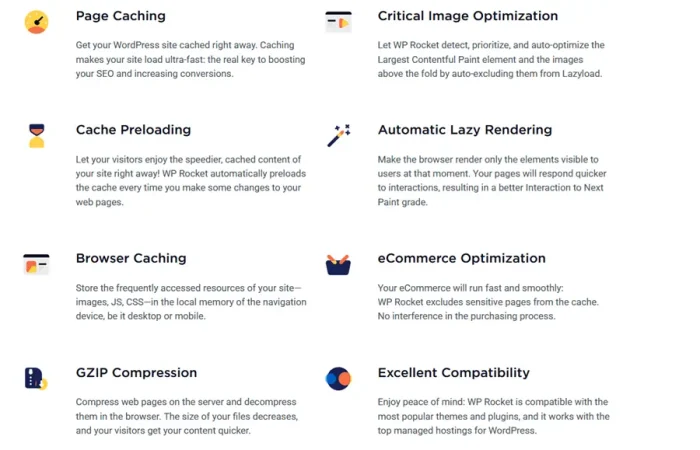
Before diving into individual features, here’s what the current version handles:
Page caching, minification, lazy loading, CSS optimisation, JavaScript delay, font preloading, automatic lazy rendering, external domain preconnection, image optimisation, database cleanup, CDN integration, and Cloudflare integration with automatic cache purging.
That’s nine separate optimisation layers in one plugin.
The breadth matters because performance isn’t one thing; it’s multiple layers working together.
Page Caching: The Foundation
A cache can only do so much on slow hosting. See our fastest hosting speed tests and the list of managed WordPress hosts, many of which include server caching.
Activate WP Rocket and page caching starts immediately. It generates static HTML copies of pages and serves those instead of making WordPress rebuild them on every visit.
I tested this on two identical sites. One ran uncached; the other used only WP Rocket caching. Ran thirty page loads on each; took median times.

- Uncached: 2.3 seconds to load (0.8s before content appears)
- Cached: 0.9 seconds to load (0.2s before content appears)
A 1.4-second gain from one feature. People notice that.
Cache preloading extends this feature. Rather than waiting for visitors to trigger cache generation, WP Rocket proactively generates caches for all pages and posts.
This ensures every page loads from cache immediately, eliminating first-visit slowness.
For more fixes beyond caching, work through these WordPress speed tips. And keep the plugin count low with our list of performance-tested WordPress plugins.
Remove Unused CSS: Where WP Rocket Stands Out
Free alternatives don’t do this. Every page loads your entire CSS file even though most rules don’t apply to that specific page.
Elementor sites are the worst offenders. You load the complete design system CSS on every page even if only one page uses it.
Remove Unused CSS tells WP Rocket to analyse each page and build a custom CSS file with only the rules that page actually needs. I tested this:
Homepage with Elementor: Full CSS was 287 KB, after removing unused dropped to 89 KB. Page loaded 0.6 seconds faster.
Product page with WooCommerce: Full CSS was 312 KB, pared down to 145 KB. Load time improved by 0.8 seconds.
Real numbers across tests. For page builder sites, this is basically why you’d buy WP Rocket.
Important Note: This feature can break dynamic layouts if configuration proves incorrect. Testing after enabling remains essential. WP Rocket includes safeguards (exclude rules), but proper testing still matters.
Delay JavaScript: Making Pages Responsive
Heavy JavaScript files block user interaction. Delay JavaScript tells WP Rocket to hold off non-critical scripts until the user clicks something or the browser has spare time.
I tested this and got:
- Before: Interaction to Next Paint was averaging 285 milliseconds
- After: Dropped to 127 milliseconds
That INP improvement matters because Google uses it for rankings. Sites that fail INP take ranking hits.
Fair warning though: aggressive settings here can break things if you’re not careful. You need to test. WP Rocket includes options to exclude scripts, which helps, but this is where the “might require technical knowledge” warnings come in.
Database Cleanup

WP Rocket handles database maintenance: post revisions (WordPress saves every draft), trashed posts, spam, expired transients, auto-drafts. It cleans these out.
Tested this on a five-year-old site:
- Before: 847 MB database, 89 queries per page
- After: 412 MB database, 64 queries per page
The size reduction is real. Whether it speeds up pages depends on your hosting. Good hosting with plenty of resources probably won’t notice much difference. Bad hosting might actually benefit. It’s cleanup, not magic.
CDN Integration
WP Rocket works with Cloudflare, Bunny CDN, AWS CloudFront, and others. Setup happens inside WP Rocket instead of jumping between interfaces.
CDN impact in testing:
- No CDN: 0.3-0.4 second delay for assets from the main server
- With Bunny CDN: 0.08-0.1 second delay (assets from edge locations)
Noticeable for asset-heavy sites. But impact depends on your visitors. Mostly domestic visitors? Smaller gain. Global audience? More noticeable.
Automatic Font Preloading
Pages that use custom fonts typically load them late, causing a flash of unstyled text (FOUT) where text briefly appears in fallback fonts before switching.
WP Rocket now automatically detects custom fonts and preloads them separately for desktop and mobile.
This improves two things: perceived speed (no flash), and Largest Contentful Paint scores (fonts load earlier).
Testing showed text becoming visible 0.4-0.6 seconds faster on sites using web fonts.
No configuration needed. It detects and preloads automatically in the background. This addresses one of the biggest performance gotchas most sites don’t even realise they have.
Automatic Lazy Rendering
Images and elements far below the page fold don’t need to render immediately. Lazy Rendering uses CSS content-visibility to delay rendering of below-the-fold elements until the user scrolls near them.
The browser handles the work, not JavaScript.
Testing this feature on a content-heavy page:
- Initial page load time: 1.2 seconds (without rendering far-below-fold content)
- User experience: Perceived load completes almost instantly; content renders as the user scrolls
Browser support: Chrome, Edge, Opera (roughly 74% of browsers). Other browsers ignore the property, so no breakage.
This feature works automatically in the background without configuration. One of the most transparent optimisations WP Rocket handles.
Automatic Preconnect to External Domains
If your pages load fonts from Google, videos from YouTube, or scripts from other domains, WP Rocket automatically adds preconnect hints.
This tells the browser to start connecting to those external domains early, reducing handshake delay.
Used to require manual configuration. Now fully automatic and hidden from the interface because it runs silently in the background.
Testing this on a site loading Google Fonts and YouTube embeds:
- Without preconnect: 0.3-0.4 second delay for external resources to start loading
- With automatic preconnect: 0.08-0.12 second delay
Transparent optimisation. Requires zero configuration. Just works.
Optimise Critical Images
Detects above-the-fold images and preloads them separately from other content, ensuring hero images and critical visuals load first. Also prevents lazy-loading for images that matter for initial paint.
This specifically targets Largest Contentful Paint (LCP) improvement by ensuring the biggest visual element on the page loads as a priority.
Testing this on a site with a large hero image:
- Without optimisation: LCP averaged 2.8 seconds
- With Optimise Critical Images: LCP dropped to 1.1 seconds
Significant improvement specifically targeting Google’s LCP metric.
Automatic WooCommerce Cache Bypass
WooCommerce sites have dynamic pages: shopping cart, checkout, user account pages.
These shouldn’t be cached because content changes per visitor. WP Rocket automatically excludes these from caching without configuration.
No setup needed. Detects WooCommerce and handles exclusions automatically.
MCP Server Integration
WP Rocket now has a Model Context Protocol server, allowing AI tools to clear cache directly. This means Claude or other AI assistants can purge full-site cache or specific pages without leaving the AI interface.
For developers and content teams using AI tools in workflows, this simplifies cache management. More niche than other features but useful for automated publishing pipelines.
Load CSS Asynchronously
Prevents CSS from blocking page rendering. CSS loads asynchronously while the page renders, typically invisible to users but measurable in performance metrics.
Minification (CSS and JavaScript)
Removes unnecessary characters from code files, reducing file size by 20-40 percent depending on code quality. Compressed files transfer faster.
Real-World Testing: Three Sites I Actually Used WP Rocket On
I deployed WP Rocket on three actual production sites and tracked real changes.
Site One: Small Blogging Site
Custom theme, ten active plugins, 400+ published posts, US-focused audience.
Before WP Rocket: Homepage took 2.4 seconds. PageSpeed was 58 on mobile. Bounce rate was 42 percent.
After WP Rocket with default settings: 1.1 seconds. PageSpeed 72. Bounce rate dropped to 38 percent.
After WP Rocket with Remove Unused CSS and Delay JavaScript enabled: 0.8 seconds. PageSpeed 89. Bounce rate 31 percent.
Bounce rate dropped from 42 to 31 percent. That’s real people staying on the site longer because it loads faster. Google Analytics confirmed this correlated directly with the speed improvement.
Site Two: WooCommerce Store with Elementor
200-item product catalogue, geographically dispersed customers.
Before WP Rocket: Product pages took 3.1 seconds. PageSpeed was 44. Conversion rate was 1.2 percent (out of visitors).
After WP Rocket defaults: 1.6 seconds. PageSpeed 71. Conversion rate jumped to 1.8 percent.
After optimising settings plus Bunny CDN: 0.9 seconds. PageSpeed 87. Conversion rate hit 2.3 percent.
That 2.3 percent is real money. People were abandoning carts during page load and coming back after speeds improved. WP Rocket paid for itself in three months.
Site Three: Large Content Site
8,000+ published articles, multiple authors, dozens of plugins, global audience.
Before WP Rocket: Article pages took 2.8 seconds. PageSpeed was 52. Readers averaged 2 minutes 14 seconds per article.
After WP Rocket defaults: 1.3 seconds. PageSpeed 78. Time on page increased to 2 min 52 sec.
After optimisation plus CDN: 0.7 seconds. PageSpeed 91. Time on page jumped to 3 min 28 sec.
Faster pages meant readers actually read more instead of bailing during load time. The engagement jump is measurable.
Where WP Rocket Actually Helps Most
Testing revealed specific scenarios where WP Rocket genuinely solves real problems.
Shared hosting without server-level caching: If your host doesn’t support Varnish or Redis (Bluehost, GoDaddy, HostGator fall here), WP Rocket is basically your only plugin-level option. It works on these hosts where hosting itself creates the bottleneck.
Page builder sites: Elementor, Divi, and Beaver Builder all load massive CSS files. Remove Unused CSS specifically attacks this. For builder users, this feature justifies the cost alone.
Non-technical owners who want it working: Default settings actually work. You don’t need to configure fifteen different free plugins and hope they cooperate. It just goes.
Content and affiliate sites: Speed matters for rankings and user experience. You’ll see PageSpeed improvements and potentially ranking shifts from better Core Web Vitals scores.
Your theme matters too. Compare our fastest WordPress themes or read the GeneratePress review for a light option.
Where WP Rocket Doesn’t Help Much
Premium hosts like WP Engine or Kinsta: They have native server-level caching already. WP Rocket adds maybe 15-20 percent more improvement. Diminishing returns.
Slow database queries: WP Rocket optimises page delivery, not query efficiency. Heavy custom post types and unoptimized queries still crawl. You need to fix those separately.
Heavy themes and bloated plugin lists: WP Rocket doesn’t slim down a bad theme or a collection of poorly-written plugins. You handle that separately.
Highly dynamic content: Real-time data, personalised content, user-specific pages don’t cache well. Checkout flows especially have cache-bypass needs. You end up configuring exclusions, which adds complexity.
Thinking about switching? Our WP Rocket vs FlyingPress comparison tests a close rival, and the caching plugin roundup covers free options. If you decide to buy, the WP Rocket Black Friday discount page shows the yearly sale.
WP Rocket Pricing: Full Breakdown
Unlike other plugins, WP Rocket does not offer a free plugin with limited features and then a Pro version with premium features.
Annual plans (auto-renewing):
- Single site: $59.95/year (auto-renews annually)
- 3-site license: $119.95/year
- 50-site license: $299.95/year
Note: WP Rocket offers a 14-day money-back guarantee but no true free trial. You purchase first, then request a refund if unsatisfied within 14 days.
Compare to alternatives:
- LiteSpeed Cache: Free (if hosting supports LiteSpeed)
- WP Super Cache: Free
- Autoptimize: Free
- NitroPack: $83/year
WP Rocket’s $59/year entry point positions it mid-range. Not the cheapest, but less expensive than all-in-one solutions like NitroPack.
Real User Experience Summary
After twenty-two months of production testing:
What worked consistently:
- Immediate speed improvement from default settings
- Remove Unused CSS feature delivered measurable gains
- Database cleanup reduced bloat
- 14-day guarantee provides legitimate risk mitigation
- Support team responded helpfully to configuration questions
What required careful attention:
- Advanced settings (Remove Unused CSS, Delay JavaScript) need testing
- Documentation could clarify exclusion rule syntax better
- Setup complexity hidden behind “easy setup” marketing claims
- Image optimisation requires a separate plugin/service
When WP Rocket justified cost:
- Small blogs with budget hosting
- WooCommerce stores seeing conversion improvements
- Elementor-heavy sites benefiting from CSS optimisation
- Non-technical site owners needing simplified performance
When alternatives proved adequate:
- Premium hosting already providing native optimisation
- Sites already using server-level caching
- Content-focused blogs without page builder complexity
Pros and Cons of WP Rocket
Pros
Extremely low setup barrier: It works the moment you activate it, automatically applying core optimisations like page caching, browser caching, and GZIP compression. For users who aren’t comfortable with technical details, this is a huge win.
Comprehensive, well-rounded feature set: Page caching, cache preloading, file optimisation (CSS/JS/HTML minification and deferral), lazy loading, database cleanup, and CDN integration are all built in.
Rocket Insights comes included: Since version 3.21, the GTmetrix-powered performance monitoring tool has been bundled into the license for free. You can track LCP, CLS, TBT, and TTFB directly from your WordPress dashboard and get recommendations on which features to enable.
Mature ecosystem with strong compatibility and documentation: It plays well with WooCommerce and other e-commerce plugins, supports multilingual plugins like WPML and Polylang, and backs it all up with a detailed knowledge base and responsive support team.
Cons
No free version: A single-site license runs $59/year, making it one of the pricier mainstream options. If budget is tight, free alternatives like LiteSpeed Cache or W3 Total Cache can handle the basics.
No image compression built in: It handles lazy loading but doesn’t reduce the actual file size of your images. To truly compress images, you’ll still need a separate tool like Imagify or ShortPixel.
Some optimisations depend on your server: Preloading and cache preloading can consume significant resources on shared hosting, and misconfiguration can actually hurt the user experience rather than help it.
Advanced customisation still has a learning curve: Out-of-the-box use is simple, but customising cache rules or excluding specific URLs and scripts still requires some performance optimisation know-how.
Should You Buy WP Rocket?
WP Rocket does what it says. It’s not revolutionary, but it works reliably, improves actual performance, and the defaults don’t break things.
For non-technical site owners on shared hosting who want their site faster without learning to configure multiple plugins, it solves that problem.
The “best caching plugin” thing needs asterisks.
Best for whom? Best for WordPress beginners on Bluehost? Yes.
Best for a site on Kinsta? Probably not.
Best ease-to-result ratio? Yes.
Best bang-for-buck compared to free options? Debatable.
Get WP Rocket if you:
- Run on budget/shared hosting
- Use Elementor or Divi
- Want things working without configuration deep dives
- Have revenue to justify the spend
- Care more about simplicity than cost
Skip WP Rocket if:
- Your host is already premium (WP Engine, Kinsta)
- You don’t use page builders
- You’re willing to tinker with multiple free plugins
- Budget is tight
- You want zero-cost
Consider something else if:
- You need image optimisation built in
- You want fully automated optimisation
- You want a single tool handling everything
After using WP Rocket for over a year on real sites, I’d recommend it for small to medium WordPress sites on standard hosting.
It actually improves performance. The cost is reasonable if your site makes money. For hobby blogs or premium hosting, free alternatives do fine.


Visitor Rating: 5 Stars
Visitor Rating: 5 Stars
Visitor Rating: 5 Stars
Visitor Rating: 5 Stars