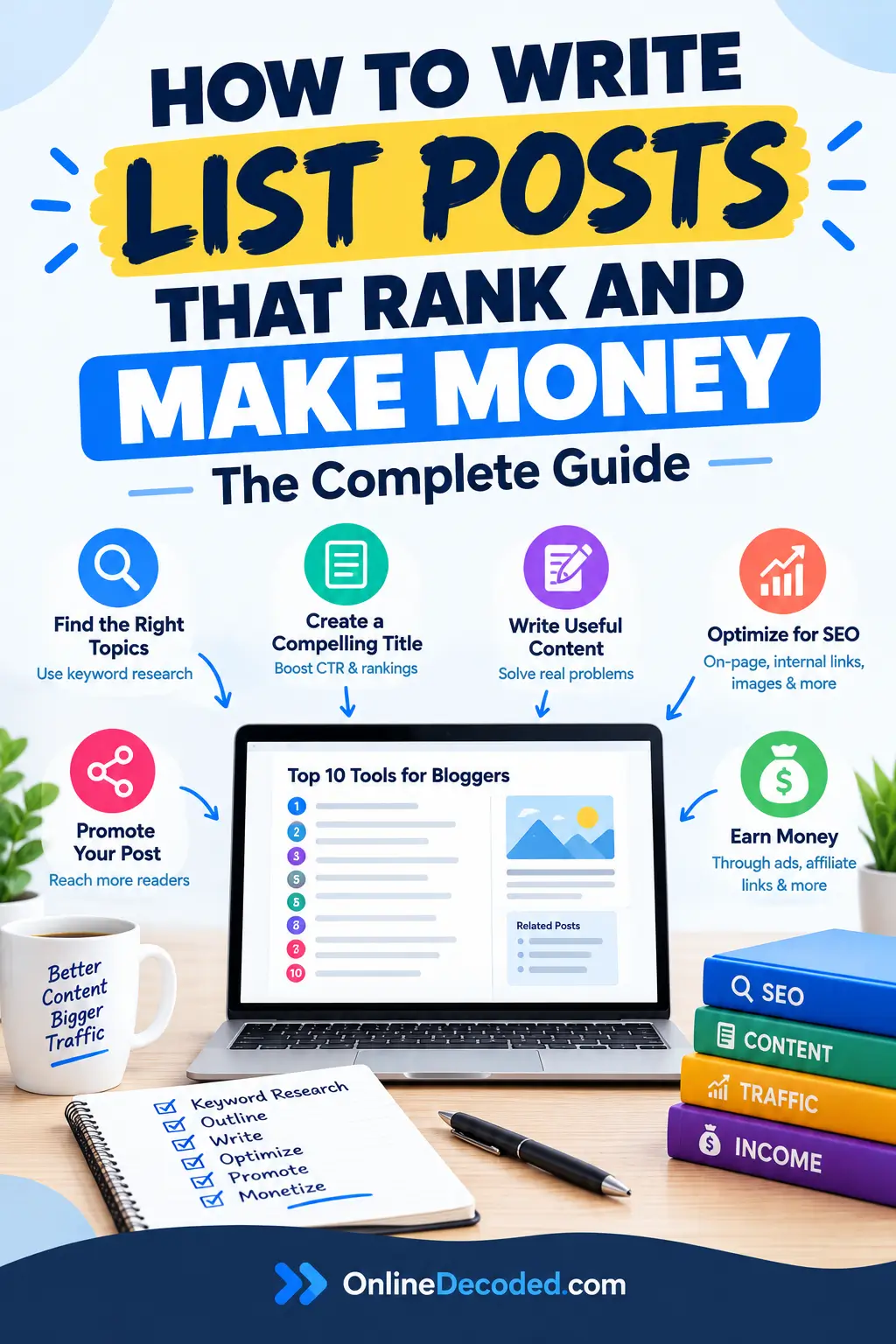
Wondering how to write list posts?
List posts are one of the most effective content formats for attracting readers, earning links, and generating revenue. They’re scannable, searchable, and shareable, which is why they continue to perform well in 2026 despite predictions that they’d become outdated.
This guide covers why list posts matter, how to write them effectively, and how to monetise them.
What are List Posts?
A list post presents information in a numbered or bulleted format. Examples: “9 Ways to Write Better Blog Posts“, “7 Tools for Social Media Marketing,” or “10 Easy Stress-Busting Tips for Bloggers“.
List posts work because readers don’t have time to read long essays. They scan lists, find useful information quickly, and decide if the post deserves more attention. This format reduces friction between reader and content.
Search engines like list posts too. Numbered list posts rank well because they provide clear, organised information that satisfies search intent efficiently.
Why List Posts Still Work in 2026?
Let us see why list posts are still preferred.
Readers Prefer Them
Scanability matters. Studies show readers spend an average of 37 seconds on a webpage. List posts deliver value in that timeframe.
Readers get ideas without investing significant time.
They Attract Links
Research shows list posts get linked more frequently than other formats. Publishers cite them as sources.
News sites reference them in roundups. Other bloggers quote them in articles.
They Rank Well
Google favours content that serves user intent. List posts satisfy the intent quickly; no fluff, no unnecessary narrative.
This quality signal helps list posts rank for competitive keywords.
They Generate Traffic
List posts are share-friendly. Social media users share them because they provide quick value.
Each share brings potential readers. More readers means more opportunity for monetisation.
They’re Easy to Update
When new items emerge, you update the list. When you add new information, the post gets fresher content. Fresh posts get ranking boosts.
This makes list posts long-term assets.
How to Write List Posts That Rank

Clarify The List Post Title Clearly
Titles matter. Vague titles get ignored. Specific titles with numbers get clicked. “Blog Tips” doesn’t work. “9 Blog Writing Tips That Increased Traffic 150%” does.
Use numbers 5-15 for best results. Research shows these perform better than “X Ways” without a specific number.
Instead of saying, 9 tips for motivation, you can say Blogging Motivation: 9 Easy Steps to Get Started.
Write Introductions That Explain the Problem
Your introduction should answer: Why does this list matter? What problem does it solve?
Don’t jump straight into the list. Spend 2-3 sentences explaining the context. Example: “High bounce rates cost you traffic and conversions. Here are 9 specific strategies to reduce yours.”
The reader should understand why they need to read this before they start the list.
Organise List Items by Value, Not Random Order
Put your best points first and second. Readers often scan the first 3-5 items only. Make them count.
Secondary points can go in the middle. Save an interesting point for last if it creates curiosity, but don’t bury your best ideas.
Organise by difficulty (easiest first), impact (highest first), or relevance to your audience. Pick one organising principle and stick with it.
Focus on Benefits, Not Just Features
People love benefits both for free and for a price.
Your list post should highlight the benefits for the people after reading it. It should not highlight the features alone.
A simple headline promising something will not attract people. It should promise how people can get more by doing less.
For example, 4 Ways to make money online is not the correct headline.
4 easy ways to make money without any investment should be the right one.
Select Only Your Best Points
You cannot write unique points in your list post.
Most of those points in every topic may already be covered in different posts or on a different blog.
To help your readers, you must pick the best points from the available ones.
Remove points that don’t add clear value. If you’re struggling to explain why something matters, it doesn’t belong.
Quality beats quantity always.
Include Calls-to-Action for Monetisation
Each list item can include a monetisation opportunity without being salesy. Affiliate links work best when they genuinely solve the reader’s problem.
Product recommendations work when they’re contextual. Internal links work when they offer related value.
Don’t force monetisation into every item, but include it strategically. If item #3 is “Use Email Marketing Automation“, link to an email platform you recommend.
Make Conclusions Actionable
End with a clear next step. What should readers do after reading your list?
“Download this checklist to implement these strategies.” “Read our complete guide on [topic].” “Try [tool] free for 30 days.” “Share this post if it helped you.”
An actionable conclusion increases engagement and conversions.
Monetisation Strategies for List Posts
Affiliate Links Within Items
This works best. If your list is “10 AI Writing Tools,” each tool can link to an affiliate partnership. The reader expects a link.
Use affiliate links where they naturally fit. Don’t force them.
Disclose affiliate relationships clearly.
Product Recommendations
Your product or a partner’s product fits naturally in list posts. “7 Ways to Improve Email Open Rates” can recommend your email course at item #5.
Include only if the product genuinely solves the problem. Readers detect forced recommendations.
Lead Generation
Gate the list itself (“Download our list of 50 Email Marketing Tools“) or offer a bonus after (“Get our email template collection“).
Offers work better than straight gates. Give value freely, then offer more value behind an email opt-in.
Display Ads
Google AdSense or similar ad networks work on high-traffic list posts. Traffic + time on page = ad revenue.
List posts generate both traffic and reading time, making them good candidates for display ads.
Strategic Internal Linking
Link to other high-value pages. “7 Email Mistakes to Avoid” links to your email guide. “9 SEO Tips” links to your SEO audit post.
Internal links build authority and funnel readers to conversion pages.
SEO Best Practices for List Posts
Optimal List Length
Research varies, but 7-15 items perform well. Specific numbers outrank generic “ways” or “tips.” “9 Blog Tips” outranks “Blog Tips.”
Odd numbers typically outperform even (7, 9, 11, 13). This is a minor factor, not a rule.
Keyword Placement
Put your target keyword in the title. Include it in the H1 and first few list items if natural.
Don’t force keyword stuffing. The title and first paragraph should include your keyword. Beyond that, write for readers, not search engines.
Formatting Matters
Use proper heading hierarchy. Title (H1), intro, list items with subheadings (H3), conclusion.
Break long explanations into 2-3 sentences per item. White space helps readability and scanning.
Link to Authority
Link to high-quality external sources when appropriate. This builds trust signals.
Internal linking is important too. Link to related content on your site.
Common Mistakes to Avoid
Padding Lists With Weak Points: Including 10 items when 7 are strong dilutes value. Stop at your best points.
No Clear Structure: Readers need to scan easily. Use consistent formatting and clear headings for each item.
Outdated or Irrelevant Items: Review and update your list periodically. Outdated information damages credibility.
Missing Calls-to-Action: Every list post should end with a clear next step. Without it, traffic leaves without engaging.
Vague Item Descriptions: Each list item needs explanation. Don’t assume readers understand why it matters. Show them.
Final words
That’s all about how to write a list post that ranks and makes money.
It will not happen with a single list post. You can create as many list posts following the tips given above and make more money.
List posts remain effective because they solve a real problem: readers need information fast. Search engines reward content that serves user intent efficiently.
Write list posts with clear value. Choose your best points. Organise logically. Monetise strategically. Update periodically.
The combination creates content that ranks, attracts readers, and generates revenue consistently.
Start with one well-executed list post. Measure results. Write more.