
Want to know how to get sponsored reviews on your blog?
Check out this detailed post to get sponsored posts on your blog and make money easily.
- How To Get Sponsored Reviews On Your Blog?
- How to Pitch Brands for Sponsored Blog Posts
- How Much Should You Charge for a Sponsored Post?
- Build Sponsorship Packages
- Negotiate and Agree on Terms Before Writing
- How to Write Sponsored Content Without Losing Reader Trust
- Test the Product Before Reviewing
- Write for the Reader, Not the Sponsor
- Don’t Publish the Sponsor’s Marketing Copy as Your Review
- Include Advantages and Limitations
- Maintain the Same Quality Standards as Editorial Content
- Decide on Niche Relevance Before Accepting
- Publish Sponsored Content at the Right Frequency
- Disclose the Sponsorship Clearly
- When You Should Reject a Sponsor
- What to Do After Publishing a Sponsored Post
- How to Turn One Sponsored Post Into a Long-Term Partnership
- FAQs related to Getting Sponsored Blog Posts
How To Get Sponsored Reviews On Your Blog?

Sponsored content can be one of your blog’s most valuable monetisation channels if approached professionally.
But many bloggers treat sponsorships as a quick money grab. They publish thin promotional content, hope the advertiser pays, and move on.
This approach occasionally works, but it leaves money on the table and damages your relationship with both readers and future sponsors.
I’ve earned more than $5,000 from sponsored content on my blogs. What I’ve learned is that getting sponsorships isn’t mainly about waiting for companies to discover you.
You need to make your blog attractive to the right companies, show them what you can offer, pitch relevant opportunities and handle the resulting partnership professionally.
There’s another critical part most bloggers overlook. Getting paid is only the beginning.
You also need to protect your readers’ trust, maintain editorial independence, disclose the sponsorship clearly and make sure paid links comply with Google’s guidelines.
This guide covers the complete process from preparing your blog and finding sponsors to pitching, pricing, writing the sponsored post and turning a successful campaign into repeat business.
What Is a Sponsored Blog Post?
A sponsored blog post is content created or published as part of a commercial relationship between a publisher (you) and a brand.
Compensation could include:
- Money (flat fee, typically $300-25,000+ depending on scope)
- Free products or services
- Free access to paid tools or platforms
- Travel or accommodation
- Discounts or affiliate commissions
- Another benefit of clear value
Sponsored content can take several forms.
Sponsored article: A company pays for content related to its product, service or industry. The brand doesn’t necessarily have to be the sole focus.
Sponsored review: You test a product or service and publish your assessment as part of a paid relationship. Payment should compensate you for your work and exposure, not purchase a guaranteed positive opinion.
Sponsored tutorial: You demonstrate how to solve a problem using the sponsor’s product.
Example: “How to Improve WordPress Performance Using [Product].”
Sponsored comparison: A sponsor may appear within a broader comparison. Editorial independence becomes particularly important because readers expect the comparison to be genuine.
Product placement: A product or service may be incorporated naturally into broader content.
Whatever format you use, readers must be able to understand when a commercial relationship exists.
Sponsored Posts vs Affiliate Marketing
These are related monetisation methods, but they’re not identical.
With a sponsorship, you receive agreed compensation for creating or distributing content.
With affiliate marketing, your income is tied to an action such as a sale, lead or signup.
Sometimes the two overlap. A company might pay you to create a review and also allow you to use an affiliate link.
When that happens, disclose both relationships and handle the links appropriately.
Can a Small Blog Get Sponsored?
Yes.
A large audience helps, but raw traffic isn’t the only thing brands consider.
A smaller site can be attractive when its audience closely matches the sponsor’s customers.
For example, a WordPress software company may get more value from a focused WordPress site with a modest but highly relevant audience than from a much larger general-interest site.
Think about sponsorship value as:
Audience relevance + trust + reach + content quality + distribution + measurable results
not just:
Monthly pageviews alone.
Prepare Your Blog Before Looking for Sponsors
Don’t start sending pitches before your site is ready.
Publish Strong Content in Your Niche
A sponsor should immediately understand what your blog covers, who reads it, what you’re knowledgeable about, and how their product could fit.
Scattered content across unrelated subjects makes the commercial proposition harder to explain.
Improve Your About Page
Explain who you are, what you cover, who the site helps, and your relevant experience.
Make Contact Information Easy to Find
Don’t make potential partners hunt for a way to reach you.
Create a Work-With-Me or Advertising Page
Explain the types of partnerships you consider, like sponsored articles, product reviews, tutorials, newsletter sponsorships, social amplification, long-term partnerships.
You don’t necessarily need to publish your rates publicly.
Make Sure Your Site Looks Professional
Before sending traffic from a prospective advertiser to your site, check:
- Mobile usability
- Broken links
- Intrusive advertising
- Outdated content
- Navigation clarity
- Author information visibility
- HTTPS enabled
- Site speed
A sponsorship pitch is partly a sales presentation for your website.
Create a Blogger Media Kit
A media kit gives prospective sponsors the essential information needed to evaluate a partnership. Keep it concise and current.
Blog Overview
Explain your niche and positioning in 2-3 sentences.
Audience Demographics
Include reliable information:
- Major countries
- Relevant audience interests
- Subscriber base (if applicable)
- Other demographics you actually have data for
Don’t invent demographic data. Unverifiable claims damage credibility.
Traffic Metrics
Use current analytics. Useful metrics include:
- Monthly users
- Pageviews
- Organic search traffic
- Traffic to relevant content categories
- Email and Social Reach
Include these only if they’re genuinely meaningful to the packages you’re selling.
Successful Content Examples
Show a few relevant articles with their traffic/ranking data.
Previous Partnerships
Include brands you’ve genuinely worked with where you’re permitted to mention them.
Sponsorship Options
Show what advertisers can buy: sponsored article, review, tutorial, newsletter mention, social amplification, etc.
Contact Information
Make the next step obvious.
Update your media kit when numbers significantly change.
Find Companies That Sponsor Bloggers
You don’t need to wait for sponsorship emails. Build a targeted prospect list.
Method 1: Check Competitor Blogs
Look at established sites in your niche.
Which brands repeatedly sponsor content? Don’t copy their campaigns. Use this research to identify companies already comfortable working with publishers.
Access their sidebars, content, and footer areas. Note which companies appear most frequently.
Method 2: Look at Products You Already Use
These are often the easiest companies to pitch because you already understand the product.
Your proposal can also be much more specific. Instead of generic “I’d like to review your product,” you can say “I’ve been using [feature] for [specific task], and I’d like to create a detailed tutorial showing my readers how I use it.”
Method 3: Study Companies Advertising in Your Niche
If a company is already spending money to reach your audience (Facebook ads, Google ads, sponsoring newsletter content), it may be open to other marketing channels.

Where to find these ads:
- Search Google for your niche keywords and check the ad results
- Browse Facebook targeting your audience and take notes on repeat advertisers
- Check your email newsletters for sponsored promotions
- Watch YouTube videos in your niche for ad patterns
Method 4: Check Companies You Already Promote as an Affiliate
Existing affiliate relationships can sometimes develop into deeper partnerships.
You may already have performance data demonstrating audience fit.
Method 5: Use LinkedIn for Contact Discovery
Search the company for roles such as:
- Partnerships manager
- Affiliate manager
- Influencer marketing manager
- PR manager
- Content marketing manager
- Digital marketing manager
LinkedIn often reveals who owns which relationships.
Method 6: Check the Company Website
Look for pages like media, press, partnerships, affiliates, marketing, or contact.
The goal is reaching the person responsible for the type of partnership you’re proposing.
Check out: Legitimate ways to make money online
Research the Brand Before Pitching
Mass outreach produces mass-outreach-quality responses.
Before emailing, understand:
- What does the company sell?
- Who is its target customer?
- What has it recently launched?
- Does it already work with publishers? (Check their website, LinkedIn, etc.)
- Which of your existing articles overlap with its audience?
- What campaign could you realistically create?
This lets you pitch an idea, rather than merely asking for money.
How to Pitch Brands for Sponsored Blog Posts
A good sponsorship pitch is short enough to read quickly but specific enough to demonstrate value.
Pitch Structure
- Introduce yourself: Explain who you are and what your publication covers.
- Establish relevance: Explain why you’re contacting this particular company.
- Show evidence: Use the most relevant metrics. Not every number in your analytics belongs in the email.
- Propose an idea: This is where many pitches fail.
Don’t say: “I am looking for sponsored post opportunities.”
Instead, propose something concrete: “I’d like to create a hands-on comparison of [product] for WordPress users choosing between X and Y. My WordPress hosting articles currently receive 2,000 monthly organic visits from your target demographic.”
- Provide a clear next step: Ask whether they’re interested in seeing the full proposal, media kit, or rate card.
Pitch Template
Subject: Content partnership idea for [Brand]
Hi [Name/Partnerships Team],

I'm [Your Name] from [Blog Name], where I publish practical content about [topic]. I'm reaching out because [specific reason the brand/product is relevant to your audience].

My content around [relevant topic] currently [specific verified traffic/ranking/audience information]. Example: "receives 2,000 monthly organic visitors from [country/demographic], with [data supporting relevance]."

I'd like to explore a sponsored [review/tutorial/comparison] focused on [specific angle]. The campaign could include:

[blog deliverable: full article, featured placement, etc.]
[newsletter/social deliverable if applicable]
[other agreed deliverable]

Here are examples of related content I've published:

[URL] [URL]

If this fits your current marketing plans, I can send my media kit and the proposed deliverables.

Regards, [Your Name] [Website] [Phone if appropriate]
Follow Up Appropriately
Yes, once or twice when appropriate. People miss emails. A short follow-up is enough.
One week after the initial email: “Hi [Name], following up on my email from [date] about a potential partnership. Let me know if you’d like to discuss further.”
Don’t send daily messages asking if they saw your email. If there’s no response after reasonable follow-up, move on. Most rejections are silent.
Let me show you an example. The following is the email I sent to a company when I was accepting sponsored posts years back.

There are two possible outcomes after you send the email. Either they will accept your request or decline it.
There are some companies that are not willing to advertise. You can expect the following email from such a company.
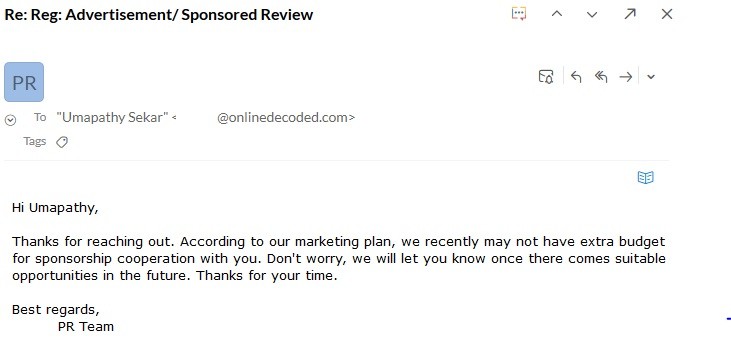
If the company is willing to work with you and promote the brand, you will get an email shown below:

Once you receive the email accepting your request, you should write an exceptional review of the product. If your review is of high quality, they will use you for future promotions. So, always try to impress them with your work.
After completing your sponsored review, they will ask for your PayPal ID. Just send your PayPal email, and they will send the money through PayPal as soon as possible.
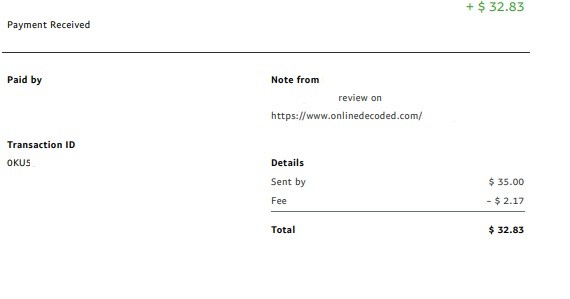
How Much Should You Charge for a Sponsored Post?
There is no universal rate that works for every blogger.
Price based on what you’re actually providing.
Research Comparable Pricing
- Look at what other bloggers in your niche charge (LinkedIn, industry forums)
- Check ProBlogger job board for sponsored content rates
- Survey other publishers if you have relationships
Calculate Cost-Based Pricing
- Research and writing: 10-30 hours
- Your hourly rate: $25-100+/hour
- Original assets (screenshots, video, custom research): $200-1,000 additional
- Minimum: $300-1,000 for straightforward sponsored content
Price by Value Components
Research and writing: A detailed product test requires more work than a simple brand mention.
Audience value: A highly targeted commercial audience may be valuable even at modest scale.
Distribution: Are you buying only the article, or also newsletter placement, social posts, homepage exposure?
Original assets: Screenshots, photographs, video, charts, original research?
Usage rights: If the sponsor reuses your article, photos or video in its advertising, that’s additional value.
Exclusivity: If they request that you don’t work with competitors for three months, price that accordingly.
Revisions: Define how many rounds are included.
Industry Standard Pricing Ranges
- Basic sponsored article (1,500-2,000 words): $500-2,000
- Comprehensive review (3,000+ words, product testing): $1,500-5,000
- Tutorial with original assets: $1,000-3,000
- Newsletter sponsorship: $200-1,000 per mention
- Long-term retainer: $2,000-10,000+/month for multiple pieces
These are guidelines, not rules. Your actual rate depends on audience size, engagement, niche, and competition.
Build Sponsorship Packages
Instead of selling only one blog post, offer packages.
Basic Package
- One 2,000-word sponsored article
- Content placed on homepage
- Price: $500-1,500
Distribution Package
- Sponsored article
- Newsletter mention
- 3 social media posts
- Price: $1,500-3,000
Campaign Package
- 2-3 articles (series or different angles)
- Newsletter series
- Social content
- Follow-up exposure/analytics reporting
- Price: $3,000-10,000
Only offer channels where you genuinely have an audience.
Negotiate and Agree on Terms Before Writing
Don’t start work based on a vague email saying, “Sounds good. Let’s collaborate.”
Agree on the details in writing.
Sponsored Post Agreement Checklist
Deliverables: Exactly what are you creating? (Article length, format, distribution, original assets?)
Publication date: When will it go live?
Payment: How much and in what currency?
Payment timing: Before publication, on publication, Net 15, Net 30?
Revision limit: How many revision rounds are included?
Editorial independence: Can the company request factual corrections? Can it veto genuine criticism?
Clarify this before accepting the project.
Disclosure: The sponsorship will be disclosed clearly.
Link treatment: Paid links will use rel=”sponsored” or rel=”nofollow” attributes.
Content ownership: Who owns the article and original assets after publication?
Usage rights: Can the sponsor reuse your screenshots, photos, or text? Where? For how long?
Exclusivity: Are you prohibited from working with competitors?
Cancellation: What happens if either side cancels after work begins?
Put important terms in writing. A simple email confirmation of key points is sufficient, though formal contracts are preferable for larger deals.
Check out: Legitimate Ways to Make Money
How to Write Sponsored Content Without Losing Reader Trust
Getting the advertiser is only half the job. The content still needs to deserve publication.
Test the Product Before Reviewing
If you’re publishing a product review, use the product.
Ask the sponsor for:
- Product access
- Trial account
- Demo environment
- Physical sample where applicable
Your article should be based on your own experience where you’re making first-hand claims.
Document your testing. Save screenshots, test results, notes, measurements, examples. These become evidence for the article.
Check out: How to Sell Photos online and Make Money
Write for the Reader, Not the Sponsor
The sponsor paid for the collaboration. The reader is still the person the article needs to serve.
Start with: “What does someone considering this product need to know before making a decision?” Then answer it.
Don’t Publish the Sponsor’s Marketing Copy as Your Review
Brands may provide specifications, press releases, feature lists, and product descriptions. Use these as reference materials, not as replacements for independent evaluation.
Verify factual claims before repeating them.
Include Advantages and Limitations
No product is ideal for everyone.
Explain:
- Strengths
- Weaknesses
- Limitations
- Ideal user profile
- Unsuitable user profile
- Relevant alternatives where appropriate
A balanced review is more useful and more credible. It also protects you from accusations of unethical promotion.
Maintain the Same Quality Standards as Editorial Content
Sponsored content shouldn’t look like the low-quality part of your website.
Apply the same standards you use for your strongest posts:
- Useful research
- Clear structure
- Original examples
- Accurate claims
- Screenshots and visual evidence
- Professional editing
- Internal linking where appropriate
- Helpful external references
Decide on Niche Relevance Before Accepting
Sponsored posts should fit your blog’s core topic.
A hosting review fits a WordPress blog. A video game review doesn’t. Your audience should think “this is relevant to why I visit this site,” not “why is this here?“
Rejecting irrelevant sponsorships protects your brand and maintains reader trust.
Check out: How to choose a Profitable Niche
Publish Sponsored Content at the Right Frequency
There’s no SEO rule saying “Publish exactly three sponsored posts for every 30 editorial posts.”
The better question is: “Is the sponsored content useful, relevant, and consistent with why people visit this site?”
A blog can damage trust with one terrible sponsorship. Another can publish multiple relevant partnerships without harming the reader experience.
General guidance is that if you publish 30 posts monthly, keep sponsored content to 3-4 maximum (10-13%). This maintains trust while building revenue.
Disclose the Sponsorship Clearly
Disclosure shouldn’t be treated as fine print.
The FTC says a material connection, including payment, free products, or discounts, requires an endorsement needs to be created. The disclosure should be easy to notice and understand.
Don’t rely solely on:
- An About page
- A general site disclosure
- Fine print at the bottom
- Ambiguous wording
Clear Disclosure Example
At the top of the article:
“Disclosure: This post is sponsored by [Brand]. I received $[amount] to create this content. The opinions and conclusions are my own.”
Or for products received:
“Disclosure: [Brand] provided a free account for testing in exchange for this sponsored review. All opinions are my own.”
Adapt the wording to accurately describe the relationship. The disclosure should reflect what actually happened.
Red Flags in Poor Disclosures
- “This post contains affiliate links” (doesn’t mention sponsorship)
- Disclosing only the affiliate relationship but hiding the paid sponsorship
- Tiny text at the bottom
- “Paid promotion” buried in the article
- No disclosure at all
When You Should Reject a Sponsor
Say no when:
The product is irrelevant: Don’t distort your site’s focus for a one-time payment.
You can’t verify important claims: Don’t put your reputation behind information you can’t substantiate.
They demand a positive review: A review isn’t credible if the verdict was purchased in advance.
They require an unqualified paid link: Don’t trade long-term search risk for a sponsorship fee.
They won’t allow disclosure: Decline immediately.
The company appears questionable: Research thoroughly. Customer complaints, legal issues, poor reputation?
The compensation doesn’t justify the work: Account for research, testing, writing, editing, distribution and rights.
They want to hide the relationship: Non-negotiable. Disclose or decline.
What to Do After Publishing a Sponsored Post
Publication isn’t the end of the campaign.
Send the Live URL
Confirm that the agreed content is published and the links work.
Complete Agreed Promotion
Publish the newsletter/social/homepage components included in the contract immediately.
Monitor Performance
Depending on the campaign, track:
- Pageviews
- Organic visits
- Outbound clicks to sponsor
- Email link clicks
- Social engagement
Only report metrics you can actually measure in Google Analytics.
Check out: Best Tips for Writing Guest Posts
How to Turn One Sponsored Post Into a Long-Term Partnership
This is where sponsorships become much more valuable.
Instead of constantly looking for new companies, build relationships with brands that already know your work.
After a Successful Campaign
Share results: Show what the partnership produced.
Suggest the logical next campaign:
- Initial campaign: Product review
- Follow-up: Product comparison
- Next: Tutorial
- Later: Newsletter sponsorship
The suggestion should make sense for the audience, not just create another invoice.
Keep the Relationship Professional
- Deliver on time
- Communicate problems early
- Send invoices promptly and correctly
- Don’t exaggerate performance
- Follow through on every commitment
Long-term partnerships are built on reliability. After one successful sponsorship, reaching out for a second is much easier than cold outreach.
Rate Increases for Repeat Sponsors
After 2-3 successful campaigns with the same sponsor, your value has increased. You’ve built a track record. Increase your rates 10-20% for future campaigns.
Most sponsors expect and accept reasonable rate increases.
FAQs related to Getting Sponsored Blog Posts
How do bloggers actually get sponsors?
Build a relevant audience, publish strong niche content, prepare evidence of your reach, create a media kit, and approach companies whose customers match your readers. Many sponsorships also arrive inbound once your site becomes established.
Do I need massive traffic to get sponsored?
Not necessarily. Audience relevance and commercial fit can matter more than raw pageviews. You need some credible way to demonstrate value to the sponsor.
How much should I charge?
There’s no universal rate. Consider audience value, traffic, research/testing, writing, distribution, original assets, usage rights, and exclusivity. Start at $500-1,000 minimum for straightforward content.
Should sponsored links be nofollow?
Google recommends rel=”sponsored” for links created through paid placements. rel=”nofollow” is acceptable. Relevance does not turn a paid link into an editorial link.
Do sponsored blog posts need a disclosure?
When there is a material relationship (payment, free products, discounts), disclose it clearly and conspicuously. The disclosure should be easy to notice and understand.
Can I write a negative sponsored review?
You should retain the ability to report your genuine experience. Discuss expectations with the sponsor before accepting. If they require a predetermined positive verdict, I’d decline.
Should I accept pre-written sponsored posts?
Be cautious. Anything published on your site affects your readers and reputation. Apply the same editorial, accuracy, disclosure, and link standards to contributed content.
Final Words
That’s all about how to get sponsored reviews on your blog and Make Money from your blog.
Getting sponsored blog posts isn’t about adding an “Advertise Here” page and waiting for companies to send money.
Treat sponsorships like a real publishing business.
Once a company says yes, the quality standard should go up, not down.
Explain both strengths and limitations. Clearly disclose the commercial relationship and qualify paid links appropriately.
Then measure what happened.
A sponsored post that produces useful content for readers, measurable value for the advertiser and fair compensation for you can lead to something much more valuable than a single payment:
A long-term brand partnership.


I view something genuinely special in this internet site.