
This CPA marketing guide for beginners starts with one fact many new affiliates miss: you do not always need a sale to earn a commission.
With CPA (cost per action) offers, you get paid when a visitor does something smaller, like submitting an email, starting a free trial or filling out a form. That makes it a friendly way to monetize a blog that is not ready to sell expensive products.
Below, I explain what CPA marketing is, how networks work, how to pick offers that suit your readers and the simple steps to start earning from it.
- CPA Marketing Guide for Beginners
- What is CPA Marketing?
- CPA Marketing Isn’t Different From Affiliate Marketing
- How CPA Marketing Works
- Start With the Offer, Not the Payout
- The Metrics That Matter
- Choose Offers Matching Your Audience
- Check the Conversion Requirements Carefully
- Traffic Sources Have Restrictions
- Organic Content as a CPA Strategy
- Paid Traffic Requires Different Math
- Don’t Build Thin Landing Pages for Search
- Compliance and Disclosure Matter
- About CPA Networks
- A Practical CPA Example
- Common CPA Mistakes
- Is CPA Marketing Still Worth It?
Quick Answer: CPA marketing pays for an action (lead, signup, trial), not only a purchase. You join a CPA network, pick offers that match your audience and promote them with tracked links. Blogs, email lists and targeted content work best for beginners. Pick offers that fit your niche, or conversions stay low. Best for bloggers who want to earn before they have a big audience.
CPA Marketing Guide for Beginners

Affiliate marketing doesn’t always require a purchase to generate commission.
An advertiser might pay when a visitor starts a trial, requests a quote, installs an app, submits a qualified lead or completes another measurable action.
That’s the foundation of CPA marketing.
But CPA marketing gets explained poorly in most guides. Older articles treat it as completely separate from affiliate marketing, then list networks that have since closed or changed. Neither approach helps.
Let’s start with how the model actually works.
What is CPA Marketing?
CPA means cost per action or cost per acquisition.
The advertiser defines an action it considers valuable and pays when that action occurs according to campaign terms.
Possible actions include qualified lead submissions, account registrations, app installations, free-trial signups, quote requests, purchases or software installations.
The action and qualification rules vary by campaign.
CPA Marketing Isn’t Different From Affiliate Marketing
This is the biggest misconception.
CPA is better understood as a compensation model commonly used within performance marketing and affiliate marketing broadly.
Traditional retail affiliate marketing pays a percentage of completed sales. A CPA offer might instead pay a fixed amount for a different qualifying action.

For example:
Retail affiliate offer: Visitor → affiliate link → $100 purchase → affiliate receives commission.
Lead-generation CPA offer: Visitor → affiliate link → legitimate quote request → affiliate receives predetermined payout.
The difference is what triggers payment, not whether it’s affiliate marketing.
You’re still being compensated for referring qualified actions. The action simply isn’t always a purchase.
CPA sits under the wider affiliate umbrella, so read my beginner’s guide to affiliate marketing if the terms are new. Many networks list both CPA and sale-based offers, as you will see in my Awin network review.
How CPA Marketing Works
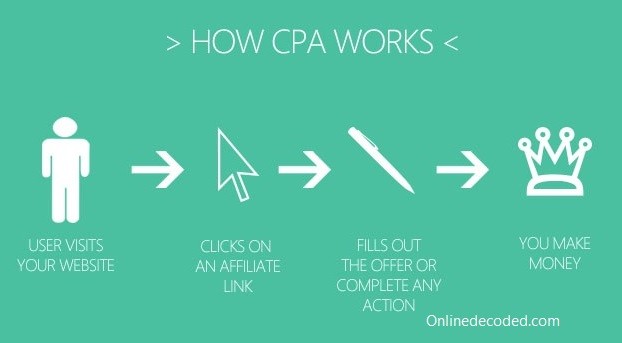
Four parties are involved in most CPA arrangements.
Advertiser: The business paying to acquire customers or actions.
Network or tracking platform: Connects offers with publishers and records conversions.
Publisher/affiliate: Promotes the offer.
Visitor/customer: Completes the required action.
A tracking link identifies which publisher referred each visitor. When the visitor completes the required action and meets campaign qualification rules, that transaction gets credited to the publisher.
Offer choice makes or breaks CPA. Use these tips for choosing the right affiliate program, and match offers to a topic using my method for picking a profitable niche.
Start With the Offer, Not the Payout
Beginners often see “$80 per lead” and assume it’s better than “$15 per lead.”
That’s meaningless without conversion data.
Suppose:
Offer A: $15 payout, 100 clicks, 10 conversions = $150 revenue
Offer B: $80 payout, 100 clicks, 1 conversion = $80 revenue
The smaller payout produced more revenue from identical traffic.
This is why experienced CPA marketers pay attention to conversion rate and EPC (earnings per click) rather than headline payout alone.
Once you have offers, you need eyes on them. Here are the best ways to promote affiliate offers on a blog, and if you have no site yet, see affiliate marketing without a website.
The Metrics That Matter
Conversion Rate
If 100 people click and five complete the required action:
5 ÷ 100 × 100 = 5% conversion rate
Earnings Per Click
If those five conversions generate $100:
$100 ÷ 100 clicks = $1 EPC
EPC is particularly useful when comparing different offers.
Return on Ad Spend
If you spent $60 acquiring traffic and generated $100:
($100 − $60) ÷ $60 × 100 = 66.7% return
This isn’t the same as net business profit because other costs exist. But it’s far more informative than staring at the headline payout.
Choose Offers Matching Your Audience
Don’t start by browsing networks for the highest payout.
Start with the audience you actually reach.
If you run a WordPress site, relevant offers involve hosting, software, website tools or business services.
A random insurance lead-generation offer might pay more per conversion. But it makes little sense if your audience didn’t visit looking for insurance.
Alignment improves both trust and conversion likelihood.
Check the Conversion Requirements Carefully
“Lead” doesn’t always mean someone merely entered an email.
The advertiser might require:
- Verified contact information
- Specific country
- Minimum age
- Completed profile
- Qualified phone call
- Payment information
- First transaction
- No duplicate account
Read campaign terms carefully. A conversion shown in a dashboard initially can be reversed if it fails advertiser validation rules.
CPA can also replace or support display ads. Compare it with earnings from AdSense and these AdSense alternatives. You can also browse simpler ways to make money online.
Traffic Sources Have Restrictions
CPA offers commonly specify permitted and prohibited traffic sources.
Depending on the campaign, restrictions apply to:
- Paid search
- Brand bidding
- Social advertising
- Incentivized traffic
- Push notifications
- Native advertising
- Coupon traffic
- Display advertising
- Organic search
Don’t assume that because a traffic source works technically, the advertiser permits it.
Violating traffic rules leads to rejected commissions or account termination.
Organic Content as a CPA Strategy
For bloggers, organic content is often the most sustainable approach because you’re building an audience rather than buying every click.
The strongest content usually solves the problem existing immediately before the conversion.
Instead of writing “Click here for a free trial,” create:
- Tutorials
- Comparisons
- Calculators
- Case studies
- Product demonstrations
- Problem-solving guides
- Alternatives pages
Introduce the offer when it genuinely solves the user’s problem.
Paid Traffic Requires Different Math
CPA offers can be promoted through paid traffic when the campaign allows it.
But paid CPA marketing is fundamentally a numbers business.
If your average earnings per visitor are lower than your acquisition cost, scaling simply accelerates losses.
Start with a controlled budget. Track campaigns using meaningful identifiers:
campaign → ad → keyword/audience → landing page → conversion
Evaluate the complete funnel rather than optimising only for cheap clicks.
Don’t Build Thin Landing Pages for Search
A landing page consisting of copied advertiser text, a few generic paragraphs and a call-to-action doesn’t give Google reason to rank it.
Google’s current guidance emphasises original information, first-hand experience and substantial value beyond summarising other sources.
Build a useful resource first. The CPA offer becomes the monetisation mechanism, not the reason the page exists.
Compliance and Disclosure Matter
CPA marketing can involve financial relationships between publisher and advertiser.
If you recommend an offer and receive compensation, disclose that clearly and conspicuously.
The FTC’s current guidance says affiliate relationships should be clear and conspicuous, and closer to the recommendation is generally better.
Don’t use vague wording like “affiliate link” if readers may not understand that you receive compensation.
Avoid misleading claims such as “guaranteed approval,” “make $500 today”, or “free” when payment is required.
Your landing page should accurately represent what happens after someone clicks.
About CPA Networks
Static “best CPA networks” lists become outdated quickly. Networks merge, close, change ownership or change publisher requirements.
Don’t publish a list without verifying every company immediately before publication.
For any network you consider, verify:
- Current active website
- Available advertiser base
- Supported verticals
- Geographic coverage
- Payment terms and minimums
- Traffic restrictions
- Publisher approval process
- Support quality
- Industry reputation
Treat the network as infrastructure.
The quality of your offer, audience and traffic matters far more than having a list of network names.
A Practical CPA Example
Imagine you publish about small-business software.
You find a permitted CPA offer paying for qualified free-trial registrations.
Instead of publishing a thin advertisement, you create:
“How to Automate Client Follow-Ups Without Hiring an Assistant“
The article explains the workflow, shows screenshots, discusses limitations and demonstrates how the software performs the task.
The CTA appears where the reader naturally needs the tool.
You track:
- 1,000 visitors
- 120 outbound clicks
- 18 qualifying registrations
- $20 commission per registration
Revenue = $360, outbound conversion rate = 15%, revenue per article visitor = $0.36
Those numbers tell you far more than the headline payout.
Common CPA Mistakes
Most expensive mistakes are straightforward:
- Promoting irrelevant offers because of high payouts
- Ignoring campaign traffic restrictions
- Buying traffic before understanding conversion economics
- Making claims the advertiser can’t substantiate
- Creating thin landing pages
- Failing to disclose financial relationships
- Attempting to manipulate conversions
- Not tracking individual traffic sources
Is CPA Marketing Still Worth It?
Yes. Performance-based customer acquisition remains a legitimate marketing model.
The sustainable approach isn’t finding a “secret CPA trick.”
Build or reach an audience with a specific problem. Find an appropriate offer. Understand exactly what constitutes a valid conversion.
Follow the advertiser’s traffic rules. Track conversion rate and EPC. Disclose your financial relationship clearly.
CPA marketing becomes much easier to understand when you stop thinking of it as an online-money shortcut and start treating it as measurable performance marketing.


