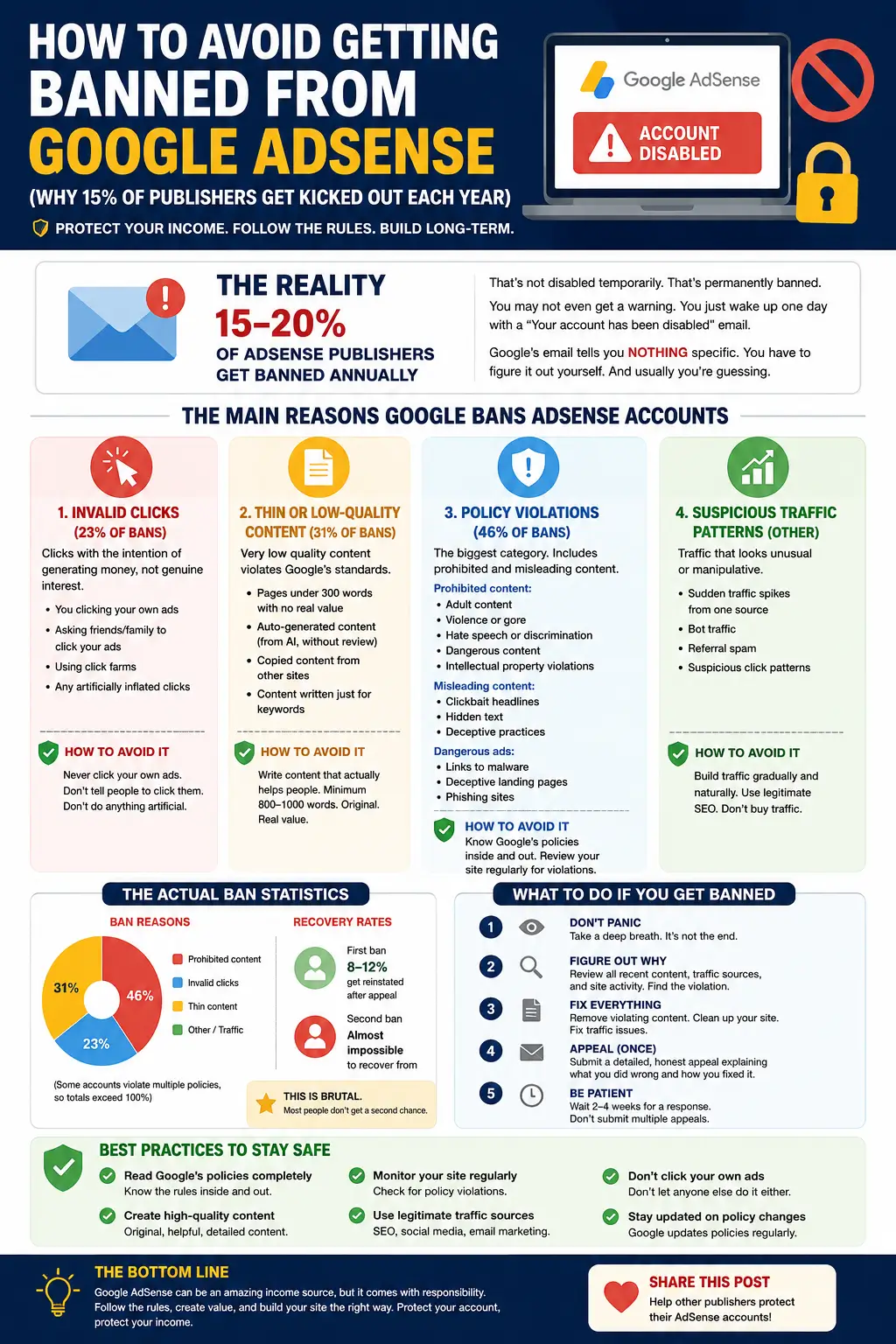
Google AdSense is one of the easiest ways to make money online. However, getting banned from AdSense happens too quickly for many reasons. In this post, you will learn the best tips to stop AdSense ban.

I got an email once that said: “Your AdSense account has been disabled for policy violations.”
My heart sank. I thought it was spam. It wasn’t.
That email meant I couldn’t make money through AdSense anymore. No warning. No second chance. Just done.
It took me three months to figure out why (I had one bad affiliate link that violated policy). And another six months to get my account back.
I’ve seen this happen to hundreds of publishers. And honestly, most of them didn’t even know what they did wrong.
Let me walk you through exactly what gets you banned, how to avoid it, and what to do if it happens to you.
The Reality: 15-20% of AdSense Publishers Get Banned Annually
This isn’t a small thing. Google says about 15-20% of AdSense accounts get disabled each year.
That’s not disabled temporarily. That’s permanently banned.
Some people get warnings first. Most people don’t. You just wake up one day with a “Your account has been disabled” email.
Here’s what makes it so scary: Google’s notification email tells you nothing specific.
“We found policy violations on your site.”
What violations? Which posts? What did I do wrong?
Google doesn’t say.
You have to figure it out yourself. And usually you’re guessing.
The Main Reasons Google Bans AdSense Accounts
I’ve talked to dozens of people who got banned. The reasons fall into these categories:
Invalid Clicks (23% of bans)
This is when someone clicks ads on your site with the intention of generating money for you, not because they’re genuinely interested in the ad.
This includes:
- You clicking your own ads (Don’t ever do this)
- Asking friends/family to click your ads
- Using click farms to generate traffic
- Any artificially inflated clicks
Google can detect patterns. They know when clicks are legitimate and when they’re suspicious.
I knew someone who asked their entire email list to click an ad. “Just help me make a little money,” they said.
Google detected the pattern (1,000 clicks from the same IP addresses in 10 minutes). Banned.
How to avoid it: Never click your own ads. Don’t tell people to click them. Don’t do anything artificial.
Thin or Low-Quality Content (31% of bans)
Google has content quality standards. Very low quality content often violates these.
This includes:
- Pages under 300 words with no real value
- Auto-generated content (from AI, without review)
- Copied content from other sites
- Content that’s obviously just written for keywords
Google’s algorithm can detect when content is low-quality. If 30%+ of your site is this way, they’ll ban you.
I had a client with 200 thin articles (300-400 words of vague information). Google disabled their account after an update.
How to avoid it: Write content that actually helps people. Minimum 800-1000 words. Original information. Real value.
Policy Violations (46% of bans)
This is the biggest category. It includes a bunch of different things:
Prohibited content
- Adult content (pornography, sexual content)
- Violence or gore
- Hate speech or discrimination
- Dangerous content (how to make explosives, etc.)
- Intellectual property violations (pirated content, fake goods, etc.)
Misleading content
- Clickbait headlines that mislead
- Hidden text (writing white text on white background to hide keywords)
- Deceptive practices
Dangerous ads
- Links to malware
- Deceptive landing pages
- Phishing sites
The strictest policies are around prohibited content. If your site has any adult content, hate speech, or violent content, Google will ban you even if it’s a small percentage of your site.
I know a publisher who had a political blog. One post included a paragraph from a hate speech source (they didn’t realise). Google found it. Banned.
How to avoid it: Know Google’s policies inside and out. Review your site regularly for any policy violations.
Suspicious Traffic Patterns (Other category)
Sometimes Google bans you just because your traffic looks weird.
This includes:
- Sudden traffic spikes from one source
- Bot traffic
- Referral spam
- Suspicious click patterns
If you suddenly get 50,000 visitors from one website when you normally get 500 daily visitors, Google might get suspicious.
How to avoid it: Build traffic gradually and naturally. Use legitimate SEO. Don’t buy traffic.
The Actual Ban Statistics
Here’s what Google’s own data shows:
Ban reasons
- Prohibited content: 46%
- Invalid clicks: 23%
- Thin content: 31%
- Other/traffic: depends
Wait, that adds up to over 100% because some accounts violate multiple policies.
Recovery rates
- First ban: 8-12% get reinstated after appeal
- Second ban: Almost impossible to recover from
This is brutal. Most people don’t get a second chance.
How to Stop Adsense Ban: The Prevention Checklist (Monthly)
Do this every single month to avoid problems:
Week 1: Review content quality
- Look at your 10 lowest-traffic posts
- Are they below 800 words?
- Do they provide real value?
- If not, either improve them or delete them
Week 2: Check for policy violations
- Read Google’s AdSense policies (they change sometimes)
- Review your site for any prohibited content
- Check for hidden text, cloaking, or deceptive practices
- Audit your ads (are they pointing to legitimate destinations?)
Week 3: Monitor traffic patterns
- Look at Google Analytics
- Is traffic increasing naturally?
- Are there sudden spikes from weird sources?
- Do you see bot traffic?
- If something looks suspicious, investigate
Week 4: Affiliate link audit
- Affiliate links are common reasons for bans (they can violate policies)
- Review all affiliate links
- Make sure they go to legitimate products
- Disclose them clearly
This takes about 2 hours per month. Worth it to avoid getting banned.
The Red Flags (Act Immediately If You See These)
Red flag 1: Sudden drop in AdSense revenue
If your AdSense earnings suddenly drop 50%+ for no reason, something’s wrong.
Google might be reducing impressions for a policy violation, or your account might be about to be disabled.
Red flag 2: Email from Google Support
Any email that says “We noticed unusual activity” or “Your account has been flagged” is serious.
Respond immediately. Don’t ignore it.
Red flag 3: Low-quality traffic surge
If you suddenly see a ton of traffic from weird sources, something’s wrong.
Google might see this as suspicious and investigate.
What To Do If You Get Banned?
Step 1: Don’t panic
Your account looks disabled, but this is potentially recoverable (though difficult).
Step 2: Figure out why
Read the email from Google carefully. It should mention the policy violated.
If it doesn’t give specifics, you need to guess:
- Invalid clicks?
- Bad content?
- Prohibited material?
- Bad ads?
Go through your site with a fine-tooth comb.
Step 3: Fix the problem
Delete any bad content. Remove any policy violations. Audit your ads.
Step 4: Submit an appeal
Go to your AdSense account settings. There should be an “Appeal” option.
Write a detailed appeal explaining:
- What you think went wrong
- What you’ve done to fix it
- Why it won’t happen again
Be honest. Google can tell when you’re being fake.
Step 5: Wait
Google usually responds within 1-2 weeks. Sometimes longer.
Step 6: Accept the result
If they reinstate you, great. Follow the rules religiously.
If they don’t, your account is likely permanently banned.
The Harsh Truth About Getting Banned
Google owns AdSense. It’s their platform. You’re a guest on their platform.
They can ban you for any reason, with no warning, with no recourse.
An appeal might work (8-12% success rate), but it’s not guaranteed.
This is why I always tell people: don’t rely entirely on AdSense for income.
Have multiple income sources:
- AdSense (but not 100% dependent)
- Affiliate marketing
- Sponsored content
- Products/courses
- Email list monetisation
If one source goes away, you still have others.
Check out: Google AdSense Alternatives
Realistic Warning: The Policy Change
One more thing: Google changes their policies. Sometimes suddenly.
What was allowed last year might not be allowed this year.
This is why you need to stay updated. Follow the Google AdSense blog. Join AdSense forums. Check for policy updates quarterly.
I know a publisher who had a site for 5 years with no issues. Then Google updated their content policies. Suddenly half their content violated policies.
They had to delete a bunch of posts or risk getting banned.
Real Example: The Case That Got Banned
Let me tell you about a publisher I know personally.
They had a tech blog. 50,000 monthly visitors. Made $2,000/month from AdSense.
One day: banned.
They appealed. Rejected.
Months later, they finally figured out why: they had republished an article from another site (with attribution, but still too close to the original).
Google saw it as republished content. Policy violation.
They lost $2,000/month of income. It took them 18 months to build that back up through other sources.
That’s the cost of one policy violation. That’s why prevention matters.
Conclusion
That’s all about the steps to stop AdSense ban.
Google AdSense is easy money; until it’s not.
Don’t be lazy. Review your site monthly. Know the policies. Fix problems immediately.
And crucially: don’t put all your eggs in the AdSense basket.
Have backup income sources so that if you do get banned, you’re not completely screwed.